
Picture this all-too-familiar scenario: It is Tuesday afternoon. You have eaten pristine salads for three days straight, turned down birthday cupcakes at the office, and tracked every single calorie with military precision. But around 3:30 PM, your energy dips, someone leaves fresh chocolate chip cookies in the breakroom, and you eat one. Immediately, a wave of guilt hits you: “Well, I blew my diet. I might as well order takeout pizza tonight and start over on Monday.”
This toxic, all-or-nothing mindset is the single biggest reason why 90% of traditional diets crash and burn within weeks. When you demand 100% nutritional perfection, a single normal human moment feels like total failure. You end up trapped in an exhausting cycle of severe restriction followed by guilt-ridden weekend binging.
There is a vastly better, scientifically proven way to achieve lasting fat loss without feeling miserable or turning down dinners with friends: the 80/20 Rule. By dedicating 80% of your meals to nourishing, whole foods and leaving 20% for your favorite soul-satisfying treats, you unlock steady fat burning while enjoying a full, happy social life. In this guide, we will break down the math, share practical meal examples, and show you how to make healthy eating feel effortless.
💡 The 80/20 Rule at a Glance
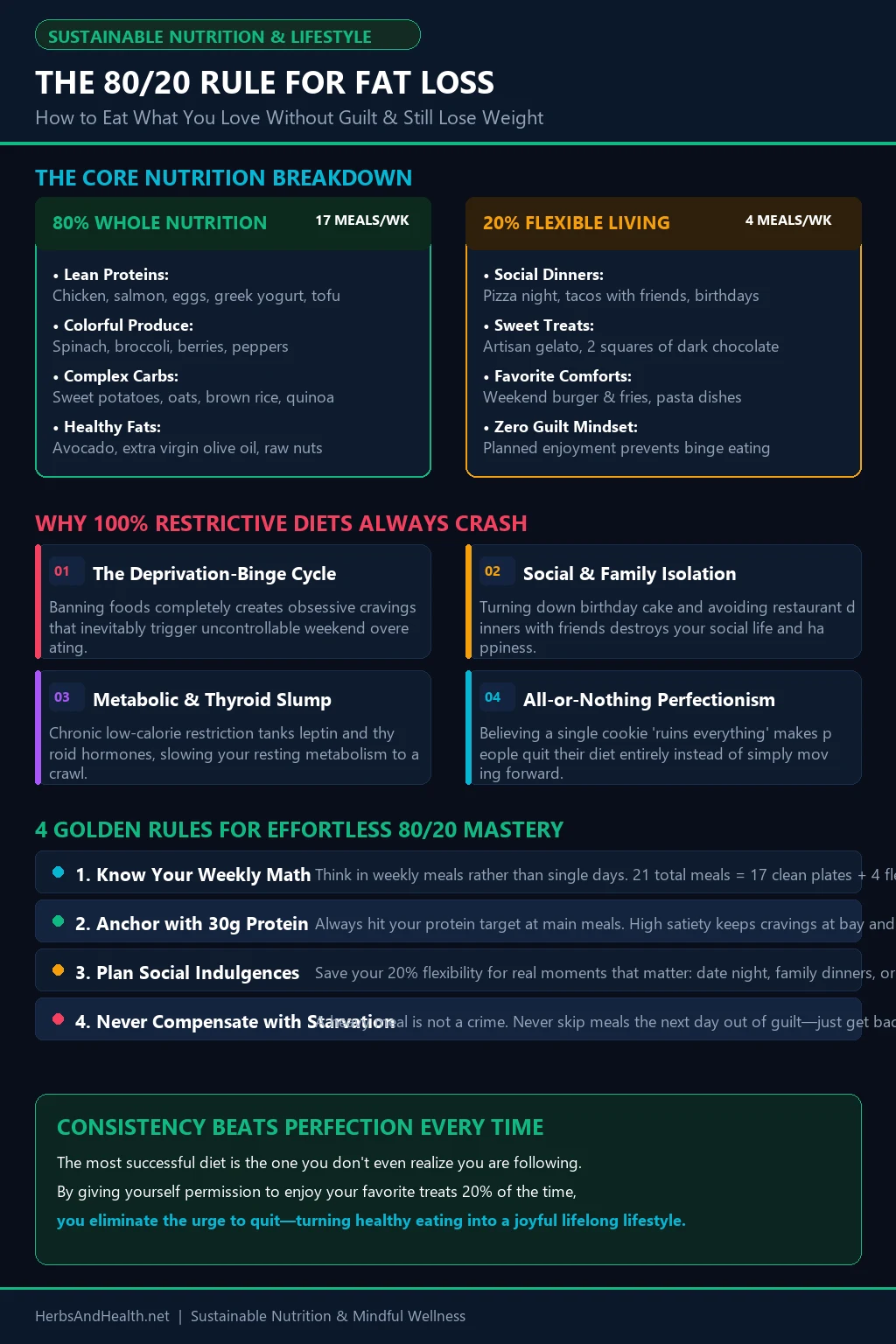
- The 80% Foundation: Whole, nutrient-dense foods, lean proteins, vibrant vegetables, fiber-rich complex carbs, and healthy fats that fuel your metabolism.
- The 20% Flexibility: Planned, guilt-free treats, pizza night, artisan gelato, a glass of wine, or your favorite comfort foods that keep cravings at bay.
- The Weekly Math: Out of roughly 21 meals per week, 17 are clean foundation meals and 4 are flexible lifestyle meals.
- Psychological Freedom: Eliminating forbidden foods cures the binge-restrict cycle, creating lifelong dietary consistency.
- Long-Term Result: Sustainable, stress-free fat loss that fits seamlessly around family, travel, and social celebrations.
What is the 80/20 Rule? (The Pareto Principle of Nutrition)
The 80/20 rule is based on the famous Pareto Principle, named after Italian economist Vilfredo Pareto, which observes that roughly 80% of outcomes result from 20% of causes. In nutrition, this concept translates into a remarkably freeing truth: 80% of your body composition and metabolic health is driven by the consistent baseline of your overall diet, not by occasional treats.
Under the 80/20 framework, you divide your weekly eating into two harmonious buckets:
- The 80% Foundation: Nutrient-dense, minimally processed whole foods. These are foods that provide essential micronutrients, steady energy, and high satiety, such as pasture-raised eggs, chicken breast, wild salmon, colorful cruciferous vegetables, quinoa, sweet potatoes, avocado, and raw nuts. When you follow our practical lunch and dinner meal guide, preparing these nourishing meals is simple, delicious, and takes minimal kitchen time.
- The 20% Flexibility: Foods eaten purely for pleasure, celebration, or emotional satisfaction. This might be a couple of slices of wood-fired pizza on Friday night, a weekend brunch with pancakes, two squares of rich dark chocolate after dinner, or a cocktail with coworkers.
Notice what is missing here: there is no guilt, no cheat day remorse, and no punishment cardio on the treadmill the following morning. The 20% is not a failure; it is a planned, respected part of your lifestyle that makes the 80% sustainable for decades rather than days.
Why 100% Restrictive Diets Always Crash & Burn
To truly appreciate the power of the 80/20 approach, you have to look at why extreme diets have a staggering 95% long-term failure rate. When you attempt to eat “100% clean” with zero room for error, several destructive physiological and psychological traps spring shut:
1. The Psychological Deprivation-Binge Loop
Human psychology operates on scarcity. The moment you declare that bread, pasta, or dessert is completely “evil” and forbidden, your brain immediately fixates on those exact foods. Cravings amplify exponentially until your willpower eventually gives out. When you finally break down, you do not just eat one cookie; you eat the entire sleeve because you believe you have already failed.
2. Social and Family Alienation
Food is fundamentally social. It connects us to our families, our heritage, and our closest friends. A diet that forbids you from sharing a slice of pizza on movie night with your kids or enjoying a birthday dinner at your favorite Italian restaurant is not a health plan, it is a social prison. Eventually, life wins, the diet breaks, and old habits return.
3. Metabolic and Hormonal Rebound
Severe, unrelenting calorie restriction signals your ancient survival mechanisms that food is scarce. Your thyroid slows production of active T3 hormones, resting metabolic rate drops, and your fat cells stop releasing leptin (the fullness hormone) while pumping out ghrelin (the hunger hormone). The body ferociously fights to regain lost weight, a phenomenon we detail in our deep dive on understanding why fat gain happens.
How to Do the Math: Two Ways to Structure Your 80/20 Routine
One of the best things about the 80/20 rule is that you can adapt it to whatever style fits your personality best. Here are the two most practical ways to calculate your balance:
Method 1: The Weekly Meal Count (Best for Most People)
If you consume three main meals per day, that equals 21 meals over a standard 7-day week:
- 80% of 21 meals = roughly 17 foundation meals: Fuel up on balanced plates featuring lean protein, fibrous greens, complex carbs, and wholesome fats.
- 20% of 21 meals = 4 flexible meals: Enjoy four meals where you eat whatever you genuinely desire without counting macros. This could be Friday date night pizza, Saturday lunch tacos with friends, Sunday brunch waffles, and a mid-week dessert.
Method 2: The Daily Plate Division
If you prefer a consistent daily rhythm rather than saving flexibility for the weekend, you can apply 80/20 to each day. If your target is 2,000 calories daily:
- 1,600 calories (80%) come from whole, nourishing foundation foods (eggs, chicken, spinach, sweet potatoes, olive oil).
- 400 calories (20%) are reserved for a daily treat, such as two scoops of ice cream, a bakery pastry, or a glass of red wine with dinner.
Both methods work identically well. The key is simply choosing the approach that brings you the greatest peace of mind and keeps your progress on track with our daily fat loss checklist.
4 Golden Rules to Master the 80/20 Lifestyle Without Gaining Weight
While the 80/20 rule offers remarkable flexibility, it is not an excuse for chaotic eating. To ensure your 20% flexibility never sabotages your fat loss goals, follow these four proven rules:
1. Anchor Every Foundation Meal with 30 Grams of Protein
Protein is the king of satiety. By ensuring that your 80% foundation meals contain 30 to 40 grams of lean protein, you keep your hunger hormones thoroughly suppressed. When your flexible meal rolls around, you will naturally feel satisfied with two slices of pizza rather than mindlessly devouring the entire box.
2. Never Compensate for Flexible Meals with Starvation
If you enjoy a rich, celebratory meal on Saturday night, the absolute worst thing you can do on Sunday morning is skip breakfast, fast for 24 hours, or do two hours of punishment cardio. Compensation reinforces the binge-guilt cycle. Instead, wake up, drink a tall glass of water, and calmly return to your normal 80% whole food routine. One meal never makes you fat, just as one salad never makes you lean.
3. Choose Quality Over Mindless Junk
Your 20% treats should be foods you genuinely love and savor. Sit down, taste every bite, and enjoy it with friends or family. Mindlessly eating stale donuts in an office hallway while checking emails is not a worthy 20% experience. Make your indulgences intentional, high-quality, and deeply enjoyable.
4. Incorporate Low-Glycemic Whole Fruits for Sweet Tooth Balance
Satisfying your sweet cravings does not always require refined sugar. Whole fresh fruits provide natural fructose paired with fiber, antioxidants, and water, delivering rich sweetness without the glycemic crash. Check our curated guide to the best fruits for fat loss to see how berries, green apples, and grapefruit effortlessly fit into your daily 80% foundation.
Helpful Tools & Essentials for Effortless 80/20 Living
Living an 80/20 lifestyle does not require complicated gadgets, but having a few reliable kitchen essentials makes meal prep seamless and portion awareness completely second nature:
Digital Stainless Steel Food Scale
Accurate to 1 gram. Perfect for building intuitive visual portion awareness for your 80% foundation proteins and healthy cooking fats without obsessive calorie counting.
Glass Meal Prep Storage Containers
BPA-free borosilicate glass containers with leakproof snap lids. Makes batch cooking your weekly 80% foundation proteins and roasted vegetables fast and organized.
Flexible Dieting & Healthy Recipe Cookbook
Packed with over 100 high-protein, mouthwatering recipes that prove healthy food never has to taste bland or boring. the primary guide to sustainable everyday cooking.
Frequently Asked Questions About the 80/20 Diet Rule
Can I still lose fat if my 20% flexible meals are high in carbohydrates?
Yes, absolutely. Fat loss is governed by your overall weekly energy balance and insulin sensitivity. As long as your total weekly calories remain in a slight deficit and your 80% foundation consists of nutrient-dense whole foods with ample protein, having high-carbohydrate treats during your flexible meals will not halt fat loss.
What if my week turns into 60/40 or 50/50 because of holidays or vacation?
Life happens, and holidays, vacations, or celebrations will occasionally shift your balance. The secret to long-term success is never panicking. Enjoy the memories, be present with your loved ones, and simply return to your 80% whole food routine when you return home. True consistency is measured across months and years, not individual weekends.
Do I need to weigh and track every single food item to do 80/20?
No. While tracking food for a week or two can be a wonderful educational tool to understand portion sizes and protein content, the 80/20 rule is designed to foster intuitive, mindful eating. Once you understand what a balanced plate looks like, you can easily eyeball your meals and live comfortably without tracking apps.
How does the 80/20 rule combine with intermittent fasting?
They complement each other brilliantly. Fasting provides a structured daily eating window (such as 16/8) that prevents late-night mindless snacking, while the 80/20 rule guides the quality of food you eat during that window. Together, they create an effortless lifestyle that burns fat while keeping food fun and flexible.
Scientific References & Peer-Reviewed Sources
- Stewart, T. M., et al. (2002). Rigid vs. flexible dieting: association with eating disorder symptoms in nonclinical women. Appetite, 38(1), 39-44.
- Smith, C. F., et al. (1999). Flexible vs. rigid dieting strategies: relationship with adverse behavioral consequences. International Journal of Eating Disorders, 26(2), 163-173.
- Palascha, A., et al. (2015). How does thinking in ‘black and white’ impact weight management? International Journal of Behavioral Nutrition and Physical Activity, 12, 105.
- Hall, K. D., & Kahan, S. (2018). Maintenance of Lost Weight and Long-Term Management of Obesity. Medical Clinics of North America, 102(1), 183-197.
Medical Disclaimer: The information in this article is for educational and informational purposes only and is not medical advice. Always consult a physician or registered dietitian before making significant dietary changes, especially if you have a history of eating disorders, metabolic conditions, or chronic medical concerns.