
Few experiences in health and fitness are more soul-crushing than stepping onto the bathroom scale after weeks of sweating in the gym, passing on workplace donuts, and eating meticulously prepared meals, only to watch the number stare back at you completely unchanged. You feel confused, exhausted, and tempted to throw your hands in the air, assuming your genetics are cursed or your metabolism is irrevocably broken. Yet clinical exercise physiologists and registered dietitians encounter this exact scenario daily: in over 90 percent of cases, a stalled scale is not a sign of broken biology. It is the result of sneaky, invisible variables silently eroding your caloric deficit.
Fat loss obeys the immutable laws of thermodynamics, but human behavior and endocrine biology are nuanced. When you diet, your body initiates subtle, subconscious defense mechanisms designed to preserve energy, conserve adipose stores, and mask actual tissue loss under fluid retention. Understanding why your progress has ground to a halt allows you to troubleshoot the stall objectively without emotional despair or self-punishment. Here are the seven most common hidden reasons you are not losing fat, and the precise, evidence-based adjustments needed to break your plateau permanently.
1. The “Eyeball Error”: Stealth Calories in Oils, Spreads, and Sauces
The most pervasive reason dedicated dieters stall is unintentional caloric underreporting. Classic metabolic ward studies published in the New England Journal of Medicine demonstrated that individuals who believed they were consuming 1,200 calories per day actually underreported their intake by an average of 47 percent while overestimating their physical activity by 51 percent.
This discrepancy is rarely deliberate dishonesty; it is the physiological reality of calorie-dense cooking fats:
- The Unmeasured Pan Pour: A single tablespoon of extra virgin olive oil contains 120 calories and 14 grams of pure fat. When you casually free-pour oil into the cooking skillet for breakfast eggs, another swirl for roasted vegetables, and a generous drizzle over your dinner salad, you can easily add 350 to 500 untracked calories without blinking.
- The “Heaping” Tablespoon: A standard level tablespoon of natural peanut butter is 16 grams (roughly 95 calories). Dipping a regular dinner spoon into the jar often yields a dense 35-gram mound, quietly turning a modest snack into a 220-calorie surplus.
- Salad Dressing Sabotage: Ordering a grilled chicken salad at a restaurant sounds virtuous, but commercial creamy dressings, candied nuts, croutons, and cheese crumbles can instantly elevate an innocent 400-calorie bowl into an 1,100-calorie energy bomb.
The fix is not neurotic restriction; it is brief, objective awareness. Invest in an inexpensive digital food scale and weigh your cooking oils, dressings, and nut butters in grams for just seven days. You will be astonished at how quickly your true caloric deficit reappears.
2. The Weekend Calorie Erase (The Monday-to-Thursday Illusion)
Consider this classic weekly scenario: Monday through Thursday, you exhibit ironclad discipline. You hit your macros, avoid snacking, and maintain a textbook 400-calorie daily deficit. Over four days, you successfully bank a 1,600-calorie deficit.
Then Friday evening arrives. You enjoy two craft beers and a bowl of tortilla chips with guacamole (+750 kcal). On Saturday, you brunch on eggs Benedict with mimosas and order takeout pizza for movie night (+1,400 kcal above maintenance). On Sunday, you share an afternoon dessert at a family gathering (+600 kcal). By Sunday night, your weekend caloric surplus totaled 2,750 calories.
When you subtract your 1,600-calorie weekday deficit from your 2,750-calorie weekend surplus, you ended the seven-day cycle in a net surplus of 1,150 calories. Biologically, your body does not operate on a calendar that resets at midnight on Sunday. It measures weekly energy balance. Even if you dieted with monk-like discipline for 80 percent of the week, the weekend surplus completely erased your progress. Learn how to navigate social dining without guilt by implementing our guide on mastering the 80/20 approach to fat loss.
7 Hidden Saboteurs Stalling Your Fat Loss Progress
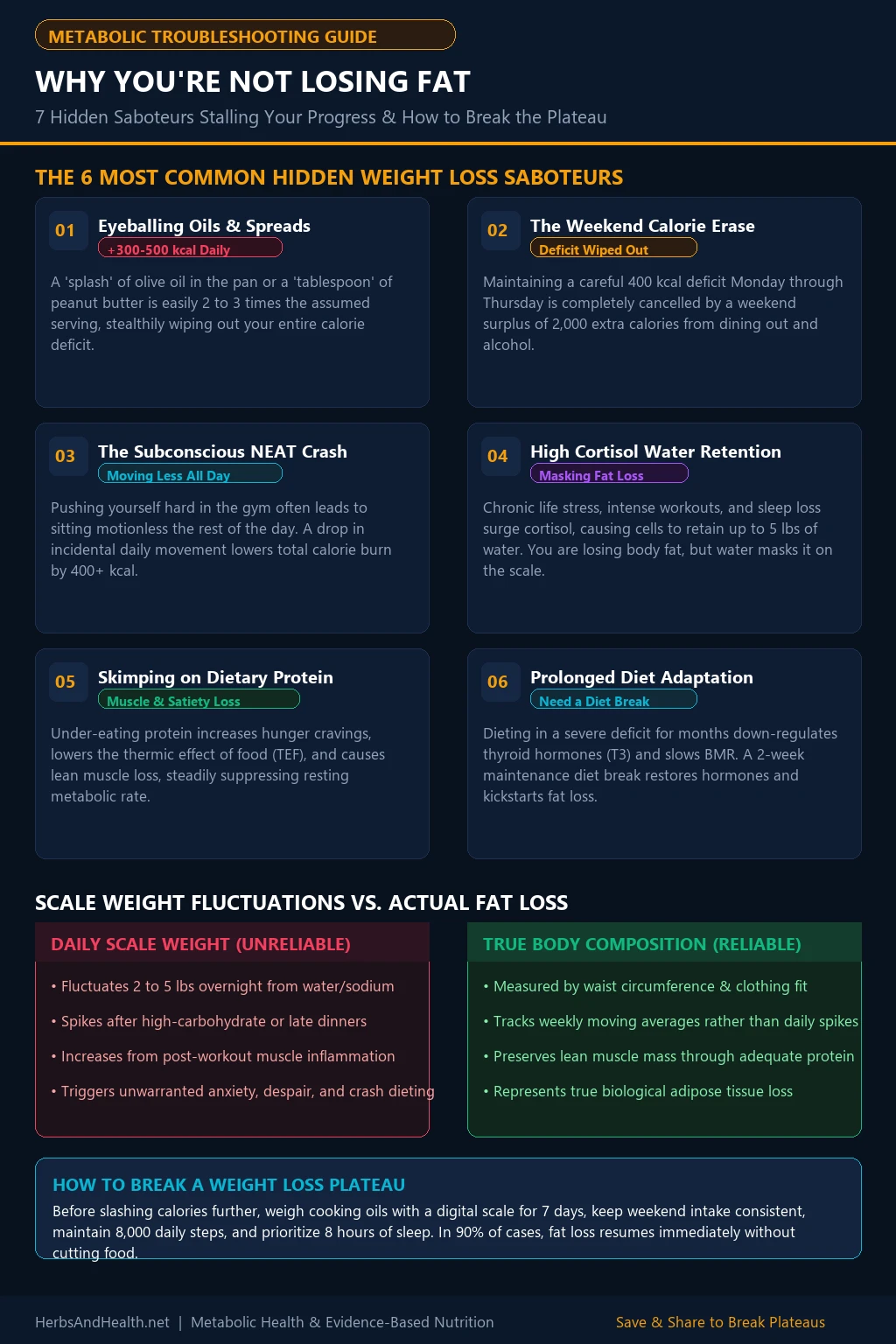
Save this visual troubleshooting matrix to Pinterest or your phone to spot hidden calorie leaks and restart consistent fat loss.
3. The Subconscious NEAT Crash (Post-Gym Inactivity)
When you begin a rigorous new exercise program, an interesting evolutionary paradox occurs. You push yourself through a grueling 50-minute workout, burning roughly 350 calories. Feeling accomplished, your subconscious brain feels entitled to rest.
Without realizing it, your Non-Exercise Activity Thermogenesis (NEAT) plummets for the remaining 23 hours of the day. You take the elevator instead of the stairs, you sit on the couch instead of pacing while talking on the phone, and you ask your partner to grab items from the kitchen so you do not have to stand up. Researchers term this “compensatory lethargy.”
A drop in incidental daily movement can decrease your daily caloric expenditure by 300 to 500 calories, completely negating the calories burned during your workout. The solution is simple: do not rely solely on the gym. Track your daily steps using your phone or smartwatch and maintain a consistent baseline of 8,000 to 10,000 steps every day, regardless of whether you had a hard gym session.
4. Chronic Stress, Sleep Debt, and Fluid Retention Masking Loss
One of the most biologically fascinating realities of fat loss is that you can be losing adipose tissue while the number on the scale remains completely static. When you place your body in a caloric deficit, train vigorously, manage work deadlines, and sleep less than seven hours a night, systemic cortisol surges.
Cortisol exerts a mild mineralocorticoid effect on your kidneys, stimulating aldosterone receptors and causing your body to retain extracellular water. Additionally, when fat cells (adipocytes) release stored triglycerides during lipolysis, they frequently fill temporarily with water before eventually shrinking. This phenomenon, known colloquially in sports nutrition as the “whoosh effect,” means you can lose two pounds of pure body fat over three weeks while your scale stays frozen due to two pounds of retained water.
Eventually, after a restorative night of deep sleep, a relaxed weekend, or a drop in stress hormones, your kidneys flush this retained fluid overnight, causing the scale to drop two or three pounds seemingly out of nowhere. Stop judging your progress solely by daily scale weight; track waist circumference, clothing fit, and monthly progress photos.
5. Skimping on Protein and Eating Too Few Whole Foods
When dieters aim to reduce calories, they frequently reach for packaged “diet foods”, 100-calorie snack packs, low-fat cereal bars, and packaged rice cakes. While these items fit into a numerical caloric limit, they lack the protein and dietary fiber required to stimulate satiety hormones.
Protein possesses a massive 20 to 30 percent Thermic Effect of Food (TEF). This means that out of 100 calories of lean protein, your body expends 25 to 30 calories just chewing, digesting, and processing amino acids. Highly processed refined carbohydrates, by contrast, require only 5 percent. When you under-eat protein, your appetite hormones (ghrelin) remain chronically elevated, your blood sugar fluctuates wildly, and you lose valuable skeletal muscle mass rather than pure adipose tissue. Anchor every meal with 30 grams of lean protein as outlined in our 6 golden rules for sustainable fat loss.
Plateau-Breaking Nutritional Tools
Support accurate portion awareness, body composition tracking, and stress recovery with these clinical tools:
Greater Goods Digital Kitchen Food Scale
High-precision digital scale measuring to the exact gram. Eliminates eyeball tracking errors for cooking oils, nut butters, and starches to instantly reveal your true caloric deficit.
RENPHO Smart Bluetooth Body Fat Scale
Bioelectrical impedance scale tracking body fat percentage, muscle mass, and visceral fat trends over time so you never mistake temporary water retention for stalled fat loss.
Organic Ashwagandha with Black Pepper
Standardized clinical adaptogen proven to lower serum cortisol by up to 28 percent, mitigating chronic stress-induced fluid retention and soothing late-night food cravings.
6. Drinking Hidden Calories in “Healthy” Beverages
Liquid calories are the most insidious dietary sabotages because they bypass oral chewing receptors and gastric stretch mechanisms. A 20-ounce bottled green smoothie marketed as a detox drink often contains 45 grams of fruit sugar and 380 calories. Similarly, oat milk lattes, sweetened kombuchas, and sports drinks add hundreds of fast-absorbing carbohydrates without producing meaningful satiety.
When you consume liquid sugar, your pancreas secretes a surge of insulin to clear glucose from the bloodstream. High circulating insulin inhibits hormone-sensitive lipase, effectively locking fatty acids inside adipose tissue and turning off fat oxidation. Replace sweetened beverages with water, black coffee, and unsweetened herbal teas as detailed in our analysis on how liquid calories ruin fat loss.
7. Severe Metabolic Adaptation: You Have Been Dieting Too Long
If you have been living in a chronic caloric deficit for six months or longer, your body’s survival mechanisms have likely down-regulated your Basal Metabolic Rate (BMR). In biology, this is termed adaptive thermogenesis: your thyroid reduces active T3 production, your nervous system lowers spontaneous movement, and your body burns significantly fewer calories than predicted by standard online calculators.
The worst reaction to this state is cutting calories even lower to 800 or 1,000 calories per day, which only accelerates muscle loss and metabolic slowdown. The correct clinical strategy is a planned two-week diet break:
- Increase your caloric intake back to your calculated maintenance level for 14 consecutive days.
- Obtain these extra calories primarily from complex carbohydrates like sweet potatoes, oats, and rice, which signal the hypothalamus that starvation has ended.
- Maintain your high-protein intake and daily 8,000 to 10,000 steps.
A structured diet break elevates leptin, restores thyroid output, lowers systemic cortisol, and resets your mental relationship with food. When you resume a gentle 400-calorie deficit two weeks later, fat loss resumes rapidly. For a practical step-by-step roadmap, review our clinical guide on 6 realistic steps to make weight loss easier.
Frequently Asked Questions About Weight Loss Plateaus
How long must the scale stay the same to be considered a true plateau?
A true weight loss plateau is defined as at least three to four consecutive weeks without any change in scale weight, body measurements, or clothing fit. Fluctuations lasting one to two weeks are almost always fluid retention caused by sodium changes, muscle inflammation, or hormonal shifts rather than stalled fat loss.
Should I do more cardio if my fat loss has completely stopped?
Rarely. Adding more cardio to an already exhausted body typically spikes cortisol, increases appetite, and causes you to move less during the rest of the day. A far more effective protocol is auditing your food intake with a kitchen scale for seven days and maintaining consistent daily walking.
Can drinking alcohol stop fat loss even if it fits my daily calories?
Yes. Because alcohol (ethanol) is a toxic byproduct that cannot be stored, your liver prioritizes metabolizing alcohol over all other macronutrients. While your liver processes alcohol, fat oxidation drops by up to 73 percent. In addition, alcohol impairs sleep quality and lowers inhibitions around high-calorie snacking.
Will eating late at night automatically stop me from losing fat?
No. Meal timing does not override total daily energy balance; calories do not become more fattening after 8:00 PM. However, late-night eating frequently involves mindless snacking on calorie-dense comfort foods directly from the pantry, which easily pushes you into a caloric surplus.
How do I know if I am losing muscle instead of fat?
If your scale weight is dropping but your waist circumference remains unchanged, your gym strength is plummeting, and your energy levels feel completely depleted, you are likely shedding lean muscle tissue. Increase your protein intake to 1.6 to 2.2 grams per kilogram and incorporate resistance training to protect muscle mass.
Peer-Reviewed Clinical References & Evidence
- Lichtman, S. W., et al. (1992). Discrepancy between self-reported and actual caloric intake and exercise in obese subjects. New England Journal of Medicine, 327(27), 1893-1898.
- Levine, J. A. (2002). Non-exercise activity thermogenesis (NEAT). Best Practice & Research Clinical Endocrinology & Metabolism, 16(4), 679-702.
- Rosenbaum, M., & Leibel, R. L. (2010). Adaptive thermogenesis in humans. International Journal of Obesity, 34(S1), S47-S55.
- Byrne, N. M., et al. (2018). Intermittent energy restriction improves weight loss efficiency in obese men: the MATADOR study. International Journal of Obesity, 42(2), 129-138.
- Chandrasekhar, K., et al. (2012). A prospective, randomized double-blind, placebo-controlled study of safety and efficacy of a high-concentration full-spectrum extract of ashwagandha root in reducing stress and anxiety in adults. Indian Journal of Psychological Medicine, 34(3), 255-265.