Quick Action Summary: Simplifying Weight Loss
- Ditch Extreme Starvation: A gentle 350 to 500 calorie deficit burns pure body fat while keeping your thyroid and metabolism protected.
- Anchor in Protein & Fiber: Aiming for 30 grams of protein and 10 grams of fiber per meal delays gastric emptying and curbs evening snacking naturally.
- Prioritize Daily Steps Over Exhaustion: Accumulating 8,000 to 10,000 daily steps burns more total weekly energy than sporadic intense gym workouts without spiking stress.
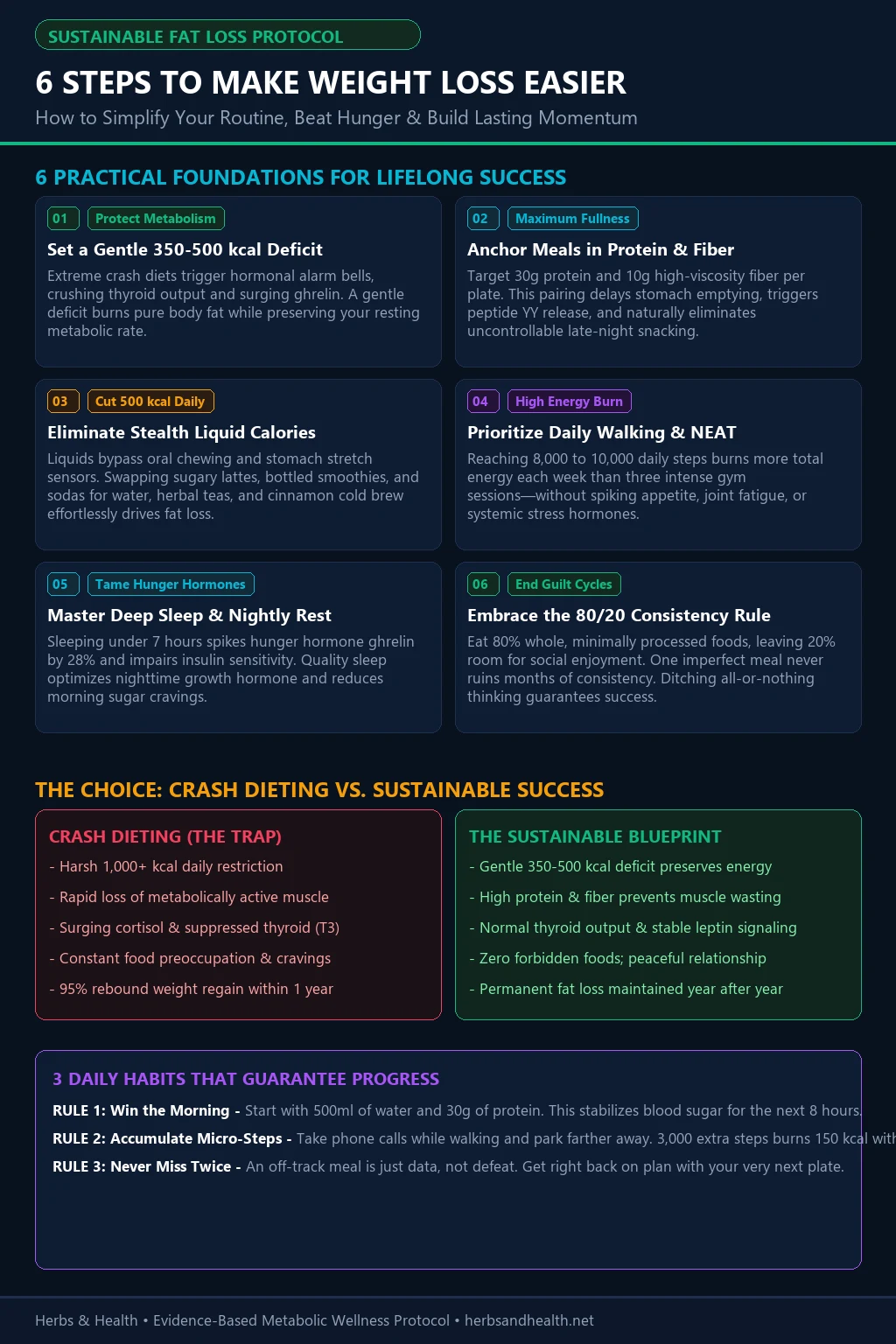
Infographic: The 6 foundational lifestyle steps to simplify fat loss, beat hunger, and avoid diet burnout.
If you have ever felt completely overwhelmed by fitness advice, you are not alone. Scroll through social media and you will find contradictory rules everywhere: cut all carbs, eat only raw fruit, or fast for twenty hours. It is enough to make anyone give up before starting.
The truth is that the diet industry profits when weight loss feels complicated, miserable, and extreme. Diets requiring you to weigh every lettuce leaf or cut out entire food groups are practically engineered to fail. When burnout hits, you blame your willpower instead of the unrealistic plan. To understand how our bodies truly store and release fat, explore our guide on understanding fat gain.
Losing weight does not have to feel like a punishing second job. The people who maintain results year after year follow a surprisingly simple, relaxed playbook. By focusing on a few high-impact daily levers, you can make steady fat loss feel manageable. Here are six realistic steps that make losing weight significantly easier without starving yourself.
Step 1: Set a Gentle Calorie Deficit (Stop Starving Your Body)
The biggest mistake people make is slashing calories in half. It feels intuitive: if eating less causes weight loss, eating almost nothing must work twice as fast. However, human biology is not a spreadsheet.
When you abruptly drop calories below your basal metabolic needs, say, eating only 1,000 calories daily, your endocrine system triggers adaptive thermogenesis:
- Thyroid Slowdown: Your thyroid reduces active T3 hormone, slowing down your resting metabolic rate.
- Leptin Collapse: Leptin (satiety) drops while ghrelin (hunger) skyrockets, causing obsessive thoughts about high-calorie foods.
- Muscle Loss: Deprived of energy, your body breaks down lean muscle tissue to scavenge amino acids for fuel.
Instead of crash dieting, aim for a conservative deficit of 350 to 500 calories below maintenance. A 400-calorie deficit yields roughly one pound of pure fat loss weekly. Your thyroid stays happy, energy remains high, and you avoid binge cycles.
Step 2: Build Every Plate Around Satiety Anchors (Protein & Fiber)
Willpower is a finite resource. If you spend your entire day fighting off stomach grumbles, cravings will eventually win. The secret to effortless fat loss is constructing meals that keep you satisfied for four to five hours. That requires two nutritional anchors: protein and dietary fiber.
Protein is the undisputed king of fat-loss nutrients. It requires significant energy to digest through the thermic effect of food (TEF), triggers satiety hormones like PYY and GLP-1, and protects lean muscle tissue during a calorie deficit so you lose fat rather than muscle.
Aim for 25 to 35 grams of protein at every meal, such as chicken breast, wild salmon, tofu, Greek yogurt, or eggs. Pair that protein with eight to ten grams of fiber from vegetables, lentils, berries, or seeds. Fiber swells in your stomach and forms a viscous gel that slows nutrient absorption, preventing insulin spikes and eliminating afternoon snack cravings. For affordable grocery ideas, review our guide on fat loss on a budget.
Step 3: Hydrate First and Cut Stealth Liquid Sugars
One of the easiest ways to accelerate fat loss without feeling hungry is addressing what flows through your straw. Liquid calories are stealth saboteurs because they bypass the chewing sensations and stomach stretch receptors that tell your brain you are full.
A morning flavored latte and an afternoon bottled green juice can easily deliver 650 calories and eighty grams of sugar. Your brain registers these calories almost like plain water, leaving your appetite unchanged while your liver is flooded with fructose. To discover the hidden traps behind everyday drinks and see zero-calorie upgrades, read our guide on how liquid calories secretly ruin fat loss.
Make a simple rule: never drink your calories on ordinary days. Drink a 500ml glass of fresh water upon waking. Throughout the day, choose sparkling water with fresh lime, cold-steeped hibiscus tea, or black coffee with cinnamon. This single adjustment frequently removes 3,000 unneeded calories every single week.
Step 4: Prioritize Daily Walking (NEAT) Over Exhausting Gym Burnout
Many people believe losing weight requires grueling two-hour gym sessions filled with breathless exhaustion. While regular strength training is fantastic for building muscle, excessive cardio often backfires when it comes to fat loss.
High-intensity workouts place heavy stress on your central nervous system, driving up cortisol and triggering intense compensatory hunger. Hours later, you find yourself ravenous, easily eating back twice the calories burned. Additionally, feeling exhausted causes you to lie on the couch the rest of the day, lowering total daily expenditure.
The real secret weapon for sustainable calorie burning is Non-Exercise Activity Thermogenesis (NEAT), the energy burned through everyday movement like walking, cleaning, and taking the stairs. Accumulating 8,000 to 10,000 steps per day burns between 350 and 500 calories without driving up hunger or stressing joints. A ten-minute walk after lunch and another after dinner also blunts post-meal blood sugar spikes by twenty-five percent.
Step 5: Protect Deep Sleep and Tame Stress Hormones
You cannot out-diet poor sleep and chronic stress. When you are chronically sleep-deprived, fat loss becomes an uphill physiological battle. Studies reveal that restricting sleep to five hours per night for just one week increases hunger hormone ghrelin by twenty-eight percent while daytime leptin drops by eighteen percent.
Sleep deprivation also impairs insulin sensitivity in muscle tissue, making your body more prone to storing incoming carbs as visceral fat. When exhausted, the brain’s prefrontal cortex powers down, while the emotional reward center becomes hyperactive, causing intense cravings for sugary comfort foods.
Treat sleep as an indispensable fat-loss habit. Aim for seven to eight hours of quality rest in a cool, dark room. Turn off bright screens sixty minutes before bed, replace evening scrolling with a warm shower or book, and stop caffeine by 2:00 PM. Lowering nighttime cortisol allows your body to produce growth hormone and burn stored fat while you rest.
Step 6: Embrace the 80/20 Mindset (Ditch the All-or-Nothing Trap)
Perhaps the most damaging habit in fitness is all-or-nothing thinking. You eat cleanly for four days, and then eat a slice of birthday cake at an office party on Friday. Instead of recognizing that one slice is harmless, you tell yourself the entire diet is ruined and binge all weekend.
This perfectionist trap keeps millions trapped in perpetual guilt cycles. The solution is adopting the 80/20 principle. Aim to get eighty percent of your calories from wholesome, single-ingredient foods, vegetables, fruits, lean meats, seafood, whole grains, and healthy fats. Reserve the remaining twenty percent for mindful flexibility: a dinner out with friends, a scoop of gelato, or a glass of wine.
One off-plan meal has never ruined anyone’s physique, just as one salad has never built one. Sustainable fat loss is about the average quality of your choices over months, not mechanical perfection over four days. For an in-depth breakdown of this flexible strategy, explore our guide on the 80/20 approach to fat loss.
Crash Dieting vs. The Sustainable Blueprint: A Direct Comparison
To see why building realistic lifestyle habits outperforms extreme restriction, examine this comparison:
3 Essential Tools to Make Everyday Fat Loss Effortless
Having reliable tools in your kitchen and daily routine eliminates guesswork and keeps you consistent. Here are three practical upgrades that simplify healthy living:
1. Accurate Digital Food Scale with Stainless Platform
Most people underestimate calories by thirty percent because eyeballing portions is unreliable. This digital scale measures grams and ounces instantly with tare precision, taking stress out of portion awareness.
Disclosure: As an Amazon Associate, Herbs & Health earns from qualifying purchases at no extra cost to you.
2. Glass Meal Prep Containers with Airtight Lids (5-Pack)
Constructed from borosilicate glass that moves safely from freezer to oven, these leakproof containers make preparing high-protein lunches ahead of time effortless, preventing impulsive fast-food runs.
Disclosure: As an Amazon Associate, Herbs & Health earns from qualifying purchases at no extra cost to you.
3. Slim Fitness Tracker & Pedometer Watch
Reaching your 8,000 to 10,000 step target becomes engaging and automatic with an unobtrusive tracker. It monitors daily steps, active calorie expenditure, and sleep quality with long battery life.
Disclosure: As an Amazon Associate, Herbs & Health earns from qualifying purchases at no extra cost to you.
A Simple 7-Day Starter Routine: How It Looks in Real Life
To see how these six steps weave into an ordinary week, here is what an uncomplicated, sustainable routine looks like in practice:
- Monday to Friday Mornings: Drink 500ml of water upon waking. Enjoy three eggs scrambled with spinach and black coffee or cinnamon cold brew. Take a brisk ten-minute walk before work.
- Midday Lunches: Pack a prepped glass container with grilled chicken breast, roasted broccoli, and a half-cup of quinoa. Walk for ten minutes around your building after eating.
- Afternoon Recharge: Sip sparkling mineral water with lime to defeat afternoon sluggishness without sugary soda or commercial energy drinks.
- Evenings: Dine on baked salmon or lean beef with a generous salad dressed with olive oil. Take a relaxing post-dinner walk with your family or listen to a podcast.
- Weekend Flexibility (The 20%): Enjoy Saturday night dining out. Eat mindfully, savor a favorite entree guilt-free, and return to your nourishing whole-food routine on Sunday morning.
Frequently Asked Questions About Simplifying Weight Loss
Why does my weight fluctuate up to 3 pounds from day to day?
Daily scale fluctuations reflect water retention, not fat gain. Short-term spikes are driven by high-sodium meals, extra carbs (glycogen binds water), muscle soreness after workouts, or hormonal cycles. Track your weekly average rather than stressing over day-to-day numbers.
Does eating carbs late in the evening automatically cause fat gain?
No, your body has no metabolic clock that converts evening food into fat. Total energy balance across the day determines results. If a balanced, protein-rich meal at 8:00 PM fits your daily calorie target, it will not hinder fat loss.
How do I handle restaurant meals without ruining progress?
Check the menu online, choose a lean protein (grilled fish or steak), request dressings on the side, and swap fries for steamed vegetables. Drink sparkling water with lime and enjoy your meal without guilt.
What should I do if my weight loss hits a plateau?
Verify that cooking oils, sauces, or snacks haven’t crept in unmeasured. If your weight has truly stalled for three consecutive weeks, trim 150 calories from your daily intake or add 1,500 daily steps to re-establish a gentle deficit.
Scientific References & Peer-Reviewed Sources
- Hall, K. D., et al. (2012). Energy balance and its components: implications for body weight regulation. The American Journal of Clinical Nutrition, 95(4), 989-994.
- Leidy, H. J., et al. (2015). The role of protein in weight loss and maintenance. The American Journal of Clinical Nutrition, 101(6), 1320S-1329S.
- Spiegel, K., et al. (2004). Sleep curtailment in healthy young men is associated with decreased leptin levels, elevated ghrelin levels, and increased hunger. Annals of Internal Medicine, 141(11), 846-850.
- Levine, J. A. (2004). Non-exercise activity thermogenesis (NEAT). Nutrition Reviews, 62(7 Pt 2), S82-S97.