
Clinical Endocrinology & Adipose Biology Summary
Clinical Status: Adipose tissue is not an inert storage depot, but an active endocrine organ that governs systemic energy homeostasis. While thermodynamic energy balance remains an inviolable physical law, the biochemical fate of ingested calories, whether partitioned into skeletal muscle repair or stored as triacylglycerols, is governed by hormonal signaling, predominantly insulin, cortisol, and leptin sensitivity.
Pathological Shift: Fat accumulation manifests through two distinct cellular mechanisms: adipocyte hypertrophy (cell swelling) and hyperplasia (cell proliferation). Visceral fat surrounding intra-abdominal organs exhibits 4x higher glucocorticoid sensitivity, draining inflammatory cytokines directly into portal circulation and driving hepatic insulin resistance.
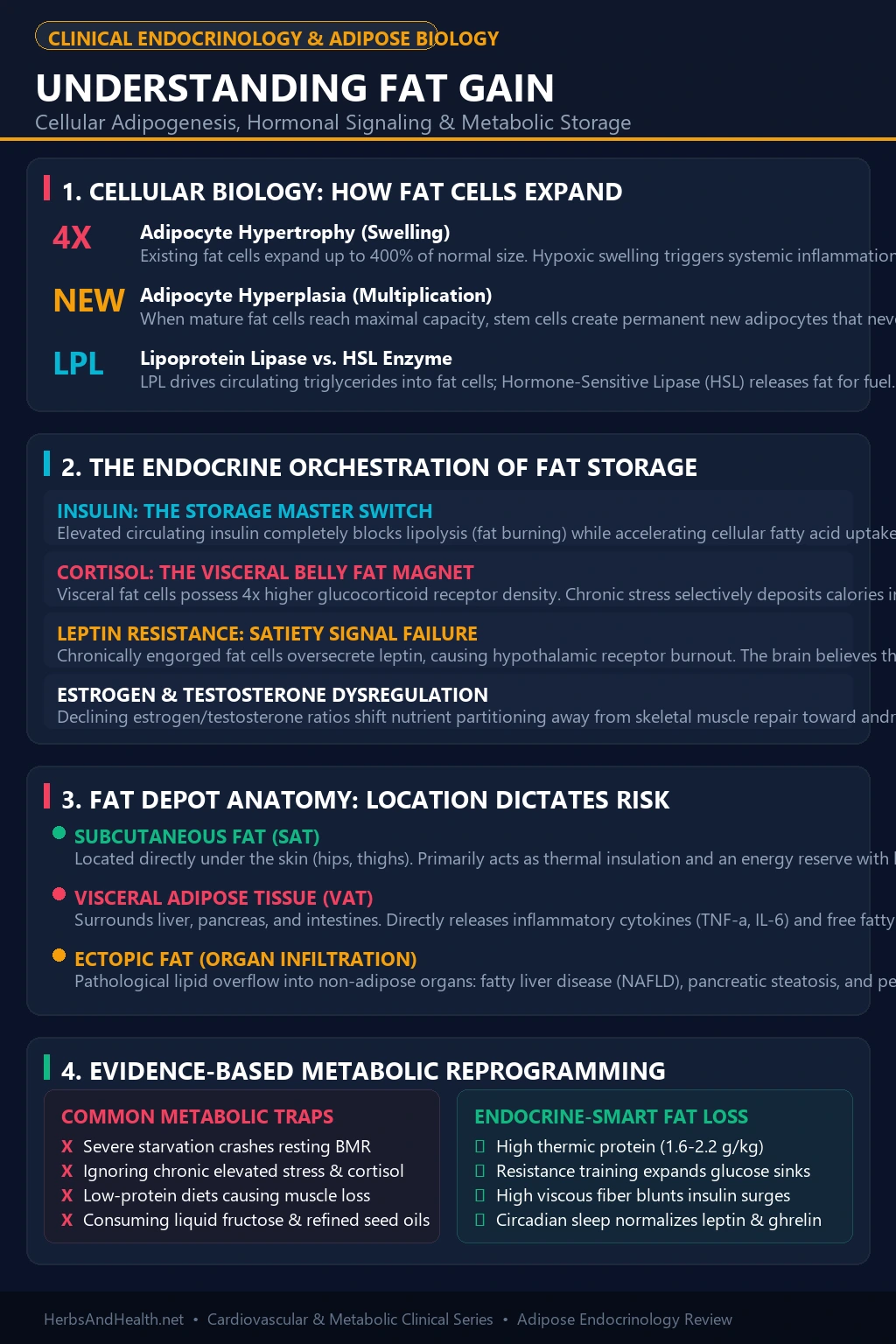
Beyond the “Calories In, Calories Out” Myth: The Cellular Reality of Fat Gain
For generations, conventional weight management has reduced fat accumulation to a simplistic mathematical equation: calories consumed minus calories expended. Under this rigid dogma, an excess of 3,500 kilocalories is said to inevitably produce one pound of body fat, regardless of whether those calories originate from refined fructose syrup or wild salmon fillet.
While the first law of thermodynamics undeniably holds true, the human body cannot create mass from nothing, the calories-in, calories-out (CICO) framework fails to explain why calories are partitioned into specific tissues. The human organism is not a bomb calorimeter measuring heat combustion in a vacuum; it is an immensely sophisticated, hormone-regulated metabolic ecosystem.
When you consume food, nutrients are broken down into circulating substrates: glucose, amino acids, and free fatty acids. The physiological decision of whether these substrates are burned for basal cellular respiration, synthesized into muscle glycogen, or esterified into adipocytes is dictated by endocrine signaling cascades. Elevated postprandial insulin acts as a one-way molecular valve, driving circulating fatty acids into fat cells while completely suppressing hormone-sensitive lipase (HSL), the primary enzyme responsible for mobilizing stored fat.
Failing to understand these hormonal switches is why chronic calorie starvation inevitably fails. As clinical analyses reveal, exploring the dangers of rapid starvation diets confirms that crash dieting crashes thyroid output and spikes appetite hormones, accelerating rapid rebound fat deposition.
Adipocyte Biology: Hypertrophy, Hyperplasia, and the Inflammatory Tipping Point
To comprehend why fat gain becomes increasingly difficult to reverse over time, one must examine the micro-anatomical behavior of the adipocyte (fat cell). Adipose tissue expands through two distinct biological pathways:
- Adipocyte Hypertrophy (Cellular Swelling): When energy surplus occurs, existing adipocytes store excess circulating fatty acids as triacylglycerols within their central lipid droplet. Individual fat cells can expand up to four times their baseline diameter. However, when an adipocyte reaches excessive dimensions, it outgrows the capillary diffusion distance of oxygen, resulting in localized cellular hypoxia. Hypoxic fat cells trigger the secretion of hypoxia-inducible factor 1-alpha (HIF-1a), recruiting pro-inflammatory M1 macrophages and releasing inflammatory cytokines (tumor necrosis factor-alpha, interleukin-6) that spill into systemic circulation.
- Adipocyte Hyperplasia (Cellular Multiplication): Once existing mature fat cells reach their critical biophysical storage limit, paracrine signaling stimulates resident pre-adipocytes to proliferate and differentiate into brand-new mature adipocytes. Crucially, once a new fat cell is created, it cannot be eliminated through natural weight loss; it can only be emptied of lipid content. This permanent increase in total fat cell number creates lasting metabolic pressure to regain lost lipid mass.
This cellular expansion is governed by two competing regulatory enzymes: Lipoprotein Lipase (LPL), which sits on the endothelial surface of adipose capillaries and pulls circulating fatty acids into fat cells for storage, and Hormone-Sensitive Lipase (HSL), which breaks down stored triglycerides into free fatty acids for energy expenditure. Chronic hyperinsulinemia continuously activates LPL while silencing HSL, locking energy inside fat cells and depriving peripheral tissues of fuel.
The Hormonal Symphony: How Insulin, Cortisol, and Leptin Govern Storage
Fat accumulation is orchestrated by four primary endocrine regulators operating in continuous feedback loops:
1. Insulin: The Master Anabolic Storage Switch
Insulin is the primary gatekeeper of human energy partitioning. When you consume refined carbohydrates and high-glycemic starches, blood glucose rises rapidly, prompting pancreatic beta-cells to secrete insulin surges. Insulin translocates GLUT-4 glucose transporters, facilitates glucose uptake into adipocytes, and stimulates de novo lipogenesis (DNL), the biochemical conversion of excess carbohydrates into palmitic fatty acids. Crucially, even modest baseline elevations in circulating insulin completely shut down lipolysis. You cannot efficiently mobilize body fat in the presence of sustained hyperinsulinemia.
2. Cortisol: The Stress-Induced Visceral Fat Magnet
Cortisol, the primary glucocorticoid produced by the adrenal cortex, plays a paradoxical role in metabolism. While acute cortisol spikes mobilize fuel during genuine emergencies, chronic low-grade elevation, driven by psychological stress, sleep deprivation, and systemic inflammation, fundamentally alters body composition. Deep visceral fat cells possess a fourfold higher density of glucocorticoid receptors compared to subcutaneous fat. Chronic hypercortisolemia selectively directs dietary triglycerides straight into intra-abdominal visceral fat depots while simultaneously breaking down lean skeletal muscle tissue.
3. Leptin: The Broken Satiety Thermostat
Leptin is an adipokine secreted by fat cells in direct proportion to total body fat mass. Under healthy physiology, leptin crosses the blood-brain barrier and binds to Ob-Rb receptors in the arcuate nucleus of the hypothalamus, signaling that energy reserves are sufficient and shutting down hunger. However, when fat cells remain chronically engorged, circulating leptin levels become chronically elevated. This constant bombardment down-regulates hypothalamic leptin receptors, creating leptin resistance. The brain becomes completely blind to the body’s vast energy reserves, perceiving a state of severe starvation and triggering uncontrollable cravings.
4. Sex Steroid Decline (Estrogen & Testosterone)
In both men and women, sex hormones govern where body fat is deposited. High testosterone in men and healthy estrogen in women favor subcutaneous fat distribution and lean muscle preservation. As testosterone drops with age or estrogen drops during menopause, lipoprotein lipase activity redistributes to central visceral fat depots, driving rapid abdominal expansion.
Clinical Comparison: Subcutaneous Fat vs. Visceral Fat vs. Ectopic Lipid Infiltration
The anatomical location of accumulated body fat dictates its systemic cardiovascular and metabolic risk profile:
| Fat Depot | Subcutaneous Adipose (SAT) | Visceral Adipose (VAT) | Ectopic Lipid Infiltration |
|---|---|---|---|
| Anatomical Location | Directly beneath the skin (hips, thighs) | Surrounding abdominal organs (omentum) | Inside liver, heart & pancreas cells |
| Blood Drainage | Systemic peripheral venous return | Direct into hepatic portal vein | Local cellular organ parenchyma |
| Inflammatory Cytokines | Low (mostly protective adiponectin) | High (TNF-alpha, IL-6, Resistin) | Severe localized lipotoxicity |
| Cardiovascular Risk | Minimal / neutral metabolic impact | Severe: Hypertension, Atheroma | Critical: NAFLD, Heart Failure |
| Responsiveness to Diet | Slower mobilization | Rapid mobilization with low insulin | Clears swiftly during calorie deficit |
Dietary Catalysts: Liquid Fructose, Seed Oils, and Hepatic Steatosis
Beyond gross caloric intake, specific modern industrial food components act as potent biochemical catalysts for pathological adipose storage:
1. High-Fructose Corn Syrup & De Novo Lipogenesis
Unlike glucose, which can be metabolized by every cell in the human body, dietary fructose is processed almost exclusively by the liver. When consumed in high concentrations (such as sodas, fruit juices, and commercial processed sweets), hepatic fructokinase bypasses the normal rate-limiting feedback inhibition of glycolysis. This inundates hepatic mitochondria with acetyl-CoA, directly stimulating de novo lipogenesis (DNL). Fructose accelerates liver fat accumulation, drives hepatic insulin resistance, and elevates circulating triglycerides far faster than equicaloric amounts of starch.
2. Industrial Refined Seed Oils & Oxidative Stress
Industrial seed oils (soybean, corn, canola, cottonseed) are rich in linoleic acid, an omega-6 polyunsaturated fatty acid prone to oxidation. Excessive dietary omega-6 incorporates into adipocyte cell membranes, increasing sensitivity to inflammatory stimuli and synthesizing endocannabinoids (2-AG and anandamide) that stimulate hypothalamic appetite receptors and drive compulsive snacking behaviors.
Managing ectopic liver fat and blood lipids is essential for systemic health; review our clinical review on natural remedies for cholesterol control to examine plant-based lipid-lowering synergies that protect against fatty liver progression.
Pure Encapsulations Chromium Picolinate
Highly bioavailable essential trace mineral that enhances insulin receptor kinase activity, supporting healthy glucose utilization and reducing carbohydrate cravings.
NOW Supplements EGCg Green Tea Extract (400mg)
Concentrated green tea extract providing 200mg of active EGCG. Clinically demonstrated to stimulate cellular thermogenesis and support resting metabolic rate.
Thorne Acetyl-L-Carnitine (High Purity)
Facilitates the transport of long-chain fatty acids into mitochondrial matrix for beta-oxidation and energy production, supporting cognitive and metabolic health.
Metabolic Reprogramming: How to Favor Lipolysis Over Fat Storage
Reversing chronic fat storage requires shifting your hormonal baseline to favor lipolysis (fat breakdown) and lean mass retention:
- Lower Postprandial Insulin AUC (Area Under the Curve): Replace high-glycemic starches with intact fibrous complex carbohydrates (lentils, chickpeas, steel-cut oats, cruciferous vegetables). Lower circulating insulin allows hormone-sensitive lipase to remain active throughout the day.
- Prioritize High Thermic Protein (1.6–2.2 g/kg): Consuming sufficient protein stimulates peptide YY and GLP-1 while preventing the skeletal muscle proteolysis that slows resting metabolic rate. For comprehensive meal structuring, explore our evidence-based metabolic weight loss plans.
- Build Contractile Skeletal Muscle Mass: Progressive resistance training expands your body’s glucose storage capacity (glycogen sinks), allowing carbohydrates to be stored in muscle rather than converted into liver fat.
- Strategic Cardiovascular Conditioning: Low-intensity steady-state (LISS) exercise oxidizes circulating fatty acids without elevating systemic cortisol; learn the optimal timing for fat-burning cardiovascular exercise to maximize lipid clearance.
Frequently Asked Questions About Fat Gain and Metabolism
Can you gain body fat while eating in a caloric deficit?
Under strict thermodynamics, gaining actual adipose tissue in a true energy deficit is biologically impossible. However, hormonal water retention caused by elevated cortisol, sodium fluctuations, or menstrual cycles can easily mask fat loss on the bathroom scale for weeks.
Why does fat accumulate primarily around the lower abdomen in men and hips in women?
Fat distribution is governed by sex steroid receptor density and alpha-2 vs. beta-2 adrenergic receptor ratios. Alpha-2 receptors inhibit fat breakdown, while beta-2 receptors accelerate it. Stubborn abdominal fat in men and lower-body fat in women have high alpha-2 receptor concentrations.
Do fat cells disappear once you lose weight?
No. When you lose body fat, mature adipocytes simply empty their intracellular triglyceride stores and shrink in volume. The total cell number remains relatively constant throughout adult life, which is why maintaining metabolic habits is essential to prevent re-expansion.
How does chronic stress directly increase belly fat?
Chronic psychological stress elevates baseline adrenal cortisol. Visceral adipocytes in the abdomen contain four times more glucocorticoid receptors than subcutaneous fat, actively pulling circulating triglycerides into deep visceral organ depots.
What is the most effective biomarker to evaluate visceral fat risk?
While BMI is crude, measuring your waist-to-height ratio (keeping waist circumference below half your height) or calculating the fasting triglyceride-to-HDL ratio (aiming below 2.0) provides a highly accurate clinical assessment of visceral adiposity and insulin resistance.
Peer-Reviewed Clinical References & Endocrine Studies
- Spalding, K. L., et al. (2008). Dynamics of fat cell turnover in humans. Nature, 453(7196), 783-787.
- Hall, K. D., et al. (2012). Energy balance and its components: implications for body weight regulation. American Journal of Clinical Nutrition, 95(4), 989-994.
- Després, J. P., & Lemieux, I. (2006). Abdominal obesity and metabolic syndrome. Nature, 444(7121), 881-887.
- Stanhope, K. L., et al. (2009). Consuming fructose-sweetened beverages increases visceral adiposity and lipids in humans. Journal of Clinical Investigation, 119(5), 1322-1334.
- Epel, E. S., et al. (2000). Stress may add bite to appetite in women: a laboratory study of stress-induced cortisol and eating behavior. Psychoneuroendocrinology, 26(1), 37-49.