Every year, millions of people experience acute cardiovascular emergencies. Yet, in daily conversation and news headlines, the terms “heart attack” and “cardiac arrest” are frequently used as if they are the exact same event. They are not.
While both are life-threatening medical emergencies involving the heart, their underlying mechanisms, physical signs, and required emergency reactions are completely different. Confusing the two can cost precious minutes, and in cardiac emergencies, every minute lost translates directly into lost heart muscle or irreversible brain damage.
Understanding this distinction is not just medical trivia; it is life-saving practical knowledge. Below is a clear, actionable guide breaking down the difference between a heart attack and cardiac arrest, the warning signs to watch for, immediate emergency steps, and daily heart-supportive habits.
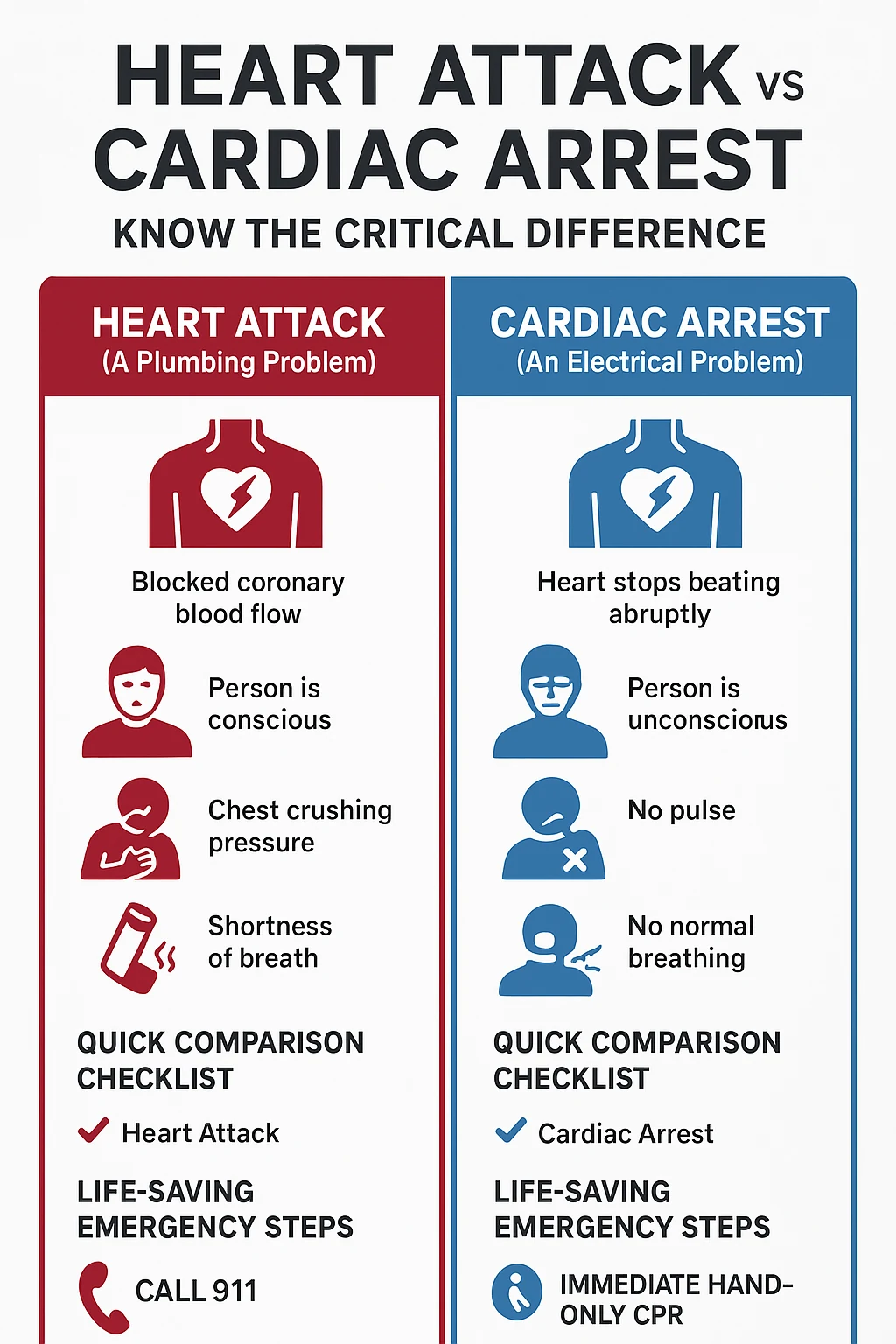
Quick Medical Summary: A heart attack (myocardial infarction) is a circulatory “plumbing” problem caused by a blocked coronary artery depriving heart muscle of oxygen, while the person typically remains conscious. Cardiac arrest is an electrical timing failure where the heart abruptly stops pumping entirely, causing immediate collapse, loss of consciousness, and cessation of normal breathing within seconds. A heart attack can trigger cardiac arrest, but they require radically different immediate responses: a conscious heart attack victim needs immediate 911 dispatch, chewing non-enteric aspirin, and resting, whereas sudden cardiac arrest demands instant 911 dispatch, continuous Hands-Only chest compressions (100–120 bpm), and rapid AED deployment within 3 minutes.
1. The Golden Analogy: Plumbing vs. Electricity
To instantly grasp the difference, cardiologists use a simple analogy:
- A Heart Attack is a “PLUMBING” Problem: A pipe supplying fresh blood to the heart muscle becomes clogged. Blood flow stops, and parts of the heart muscle begin to suffer from oxygen starvation. However, the heart keeps beating, and the person is usually conscious and talking.
- Cardiac Arrest is an “ELECTRICAL” Problem: The heart’s internal electrical timing system abruptly malfunctions. The heart unexpectedly stops pumping blood to the rest of the body. Within seconds, the person collapses, loses consciousness, stops breathing normally, and has no detectable pulse.
While a heart attack can sometimes trigger an electrical malfunction that leads to cardiac arrest, the two remain fundamentally distinct events requiring different immediate responses.
2. What Is a Heart Attack? (Myocardial Infarction)
A heart attack occurs when one of the coronary arteries, the blood vessels that wrap around the heart and supply its muscle tissue with oxygen-rich blood, becomes severely narrowed or completely blocked. This blockage is typically caused by the rupture of an atherosclerotic plaque, which triggers a rapid blood clot (thrombus). According to consensus cardiology guidelines in the European Heart Journal (PubMed PMID: 33742448), acute myocardial infarction occurs when ruptured plaque triggers occlusive coronary thrombosis. For distinguishing transient ischemia from acute infarction, see our guide to angina symptoms and treatment.
Without immediate blood supply, the affected segment of heart muscle begins to die. The longer the artery remains blocked without emergency intervention (such as clot-busting medication or a stent in the cardiac catheterization lab), the greater the permanent damage.
Classic Warning Signs of a Heart Attack
Before a total thrombotic occlusion triggers an acute infarction, many individuals experience recurrent, warning episodes of angina pectoris (coronary ischemia) during physical exertion or acute stress. Recognizing these early ischemic warning signs allows for elective outpatient cardiology evaluation before irreversible muscle damage occurs.
Heart attack symptoms can build up gradually over hours or even days, though they can also strike with sudden intensity:
- Chest Discomfort: Uncomfortable pressure, squeezing, fullness, or pain in the center or left side of the chest that lasts more than a few minutes, or that goes away and comes back.
- Radiating Pain: Pain or aching that spreads to one or both arms (especially the left arm), upper back, neck, jaw, or stomach.
- Shortness of Breath: Feeling winded or unable to catch your breath, often occurring before or alongside chest discomfort.
- Cold Sweats & Clamminess: Suddenly breaking out into an unexplained cold, profuse sweat.
- Nausea & Lightheadedness: Feeling unusually dizzy, faint, or experiencing unprovoked stomach distress.
Crucial Note: Subtle Symptoms in Women
While men frequently experience the classic “elephant sitting on my chest” crushing pain, women are much more likely to experience atypical symptoms. These include sudden profound exhaustion, persistent upper back or shoulder blade pain, jaw tightness, and severe indigestion-like burning without dramatic chest pain. Never ignore these signs. Atypical ischemic pain often radiates to the thoracic spine; explore our guide to back pain causes and red flags. Additionally, managing circulating lipids is vital; read our study report on how avocado lowers oxidized LDL cholesterol.
3. What Is Sudden Cardiac Arrest? (SCA)
Sudden Cardiac Arrest (SCA) is an electrical emergency. It occurs when a sudden disruption in the heart’s normal sinus rhythm triggers a chaotic, dangerously rapid arrhythmia, most commonly Ventricular Fibrillation (V-Fib). In V-fib, the heart’s lower chambers quiver uselessly at 300 to 500 times per minute instead of contracting smoothly.
Because the mechanical pump instantly fails, blood flow to the brain, lungs, and vital organs stops immediately. Without immediate emergency action, death occurs within 4 to 8 minutes.
Warning Signs of Cardiac Arrest
Cardiac arrest is sudden and dramatic. There is rarely an early warning window:
- Sudden Collapse: The individual abruptly falls to the ground without warning.
- Loss of Consciousness: The person is completely unresponsive to shaking, shouting, or tactile stimulation.
- Absence of Normal Breathing: The person is not breathing, or exhibits only occasional, noisy “agonal gasps” (reflexive gasping sounds that are not true breathing).
- No Pulse: There is no detectable carotid or wrist pulse.
4. Head-to-Head Comparison: Heart Attack vs. Cardiac Arrest
The table below summarizes the key differences at a glance:
| Feature | Heart Attack | Sudden Cardiac Arrest |
|---|---|---|
| Underlying Cause | Plumbing: Blocked coronary artery starving heart muscle of blood | Electrical: Disrupted rhythm causing heart to stop pumping |
| Is the Person Awake? | Yes, usually conscious and able to speak, though in distress | No, instantly unconscious and completely unresponsive |
| Is the Heart Beating? | Yes, the heart continues pumping blood | No, the heart has stopped effectively pumping |
| Breathing Status | Normal or short of breath, but actively breathing | No breathing, or abnormal dying gasps (agonal breaths) |
| Common Symptoms | Chest pressure, radiating arm/jaw pain, cold sweat, nausea | Sudden collapse, instant blackout, zero pulse |
| Immediate First Action | Call 911 immediately, then chew 325 mg aspirin | Call 911, start CPR immediately, deploy an AED |
| Definitive Medical Fix | Hospital catheterization (stent) or clot-dissolving drugs | Electrical defibrillation (AED shock) + CPR chest compressions |
5. Emergency Action Guide: What to Do in the First 3 Minutes
When an emergency strikes, taking the right action immediately makes the difference between complete recovery and tragedy:
If You Suspect Someone Is Having a Heart Attack:
- Call 911 (or Your Local Emergency Number) First: Never drive yourself or wait to see if symptoms pass. Paramedics can begin diagnostic ECGs and heart treatments right in the ambulance.
- Chew One Adult Aspirin (325 mg): Unless the person has a known severe aspirin allergy or recent internal bleeding, chew one full-strength (325 mg) or four low-dose (81 mg) chewable aspirins. Chewing accelerates absorption into the bloodstream, where it helps inhibit platelets from enlarging the blood clot.
- Stay Calm and Rest: Sit down in a comfortable position (such as leaning back against a wall with knees bent). Loosen tight clothing around the neck and chest. Do not walk around or exert yourself.
If You Witness Someone Collapse in Cardiac Arrest:
- Call 911 Immediately: Put the phone on speaker so the dispatcher can guide you while your hands remain free.
- Start Hands-Only CPR: Place the heel of one hand in the center of the chest, place your other hand on top, and push hard and fast. Aim for a rate of 100 to 120 compressions per minute (to the beat of the classic song *”Stayin’ Alive”*). Allow the chest to fully recoil between compressions. You do not need to do mouth-to-mouth rescue breaths; continuous chest compressions keep oxygenated blood circulating to the brain.
- Use an Automated External Defibrillator (AED): If a public AED is available nearby, send someone to get it. Turn it on immediately; modern AEDs give clear spoken voice prompts and will only deliver an electrical shock if the heart is in a shockable rhythm.
6. Everyday Prevention: Evidence-Based Heart Health Habits
While acute emergencies require emergency medicine, preventing coronary artery disease and electrical arrhythmias begins with daily lifestyle and nutritional choices:
- Know Your Numbers: Monitor blood pressure (aim for below 120/80 mmHg), fasting glucose, and advanced lipid markers (ApoB and hs-CRP) annually.
- Move Daily: Engaging in 30 minutes of moderate aerobic activity (brisk walking, swimming, cycling) enhances vascular elasticity and lowers resting heart rate.
- Targeted Nutritional Support:
- Coenzyme Q10 (Ubiquinol): The heart muscle consumes immense cellular energy (ATP). Ubiquinol supports mitochondrial energy production in cardiac tissue and is especially valuable for anyone taking statin medications, which naturally deplete CoQ10.
- Omega-3 Fatty Acids (EPA & DHA): Abundant in fatty fish, high-purity omega-3s help reduce serum triglycerides, support healthy blood viscosity, and stabilize myocardial cell membranes.
- Hawthorn Berry (Crataegus): Revered in botanical medicine for centuries, standardized hawthorn extract contains oligomeric proanthocyanidins (OPCs) that support coronary microcirculation and healthy endothelial function.
- Magnesium (Glycinate or Taurate): Magnesium is a vital electrolyte that regulates smooth muscle relaxation and smooth cardiac electrical conductivity.
7. Clinician-Selected Heart Support Essentials
For daily nutritional cardiovascular support, ingredient purity and third-party testing are paramount. Below are clinician-recommended, high-potency formulations available on Amazon:
Top Quality Daily Cardiovascular Support Formulations
Qunol Mega Ubiquinol CoQ10 100 mg (120 Softgels)
Active antioxidant form of CoQ10 that is up to 3x better absorbed than standard ubiquinone. Essential for cellular cardiac energy and optimal heart muscle function, especially for statin users.
Nordic Naturals essential Omega 1280 mg (120 Softgels)
Doctor-recommended high-potency EPA and DHA in the superior triglyceride molecular form for optimal cellular absorption. Third-party purity tested with fresh lemon taste and zero fishy burps.
Doctor’s Best High Absorption Magnesium (240 Tablets)
100% chelated TRAACS magnesium bisglycinate that supports smooth vascular relaxation, nerve signaling, and steady cardiac rhythm without gastrointestinal upset.
Related Cardiovascular & Circulation Guides
Explore complementary clinical guides on emergency cardiac care, arterial elasticity, and natural vascular protection:
- Angina Pectoris Guide: Symptoms, Causes, Treatment & Natural Vascular Support
- Rapid Blood Pressure Reduction: Science-Backed Natural Ways to Lower Hypertension Safely
- 30 Best Herbs for High Blood Pressure: Complete Compendium of Cardiotonic Botanicals
- Avocado & Cholesterol: How Daily Intake Lowers Oxidized LDL & Protects Arteries
Related Clinical Cardiology & Vascular Guides
- Angina Clinical Guide: Ischemic Symptoms, Spasms & Emergency Protocols
- Avocado & Cholesterol Science: LDL Reduction & Arterial Health
- Rapid Blood Pressure Reduction: Safe Emergency Methods & Vagal Maneuvers
- 30 Best Herbs for Hypertension: Science-Backed Circulation Botanicals
- Back Pain Relief & Red Flags: Differentiating Musculoskeletal from Ischemic Pain
Frequently Asked Questions (Clinical FAQ)
Can a person survive a heart attack without realizing it?
Yes. Approximately 20% to 45% of all heart attacks are classified as “silent myocardial infarctions.” In these events, the blockage causes heart muscle damage without severe chest pain, often being dismissed as mild flu, muscle strain, or heartburn. Silent heart attacks are particularly common in individuals with diabetes (due to diabetic autonomic neuropathy dulling pain receptors) and in elderly women.
Can a heart attack lead to cardiac arrest?
Yes. A heart attack is the single most common cause of sudden cardiac arrest. When a blocked coronary artery starves a segment of heart muscle of oxygen, the dying muscle tissue can become electrically unstable, triggering a catastrophic ventricular arrhythmia (V-Fib) that causes the heart to stop pumping abruptly.
Why is Hands-Only CPR recommended over mouth-to-mouth?
According to the peer-reviewed American Heart Association Guidelines for CPR and Emergency Cardiovascular Care (PubMed), continuous high-quality chest compressions are far more critical than rescue breaths. The victim’s bloodstream still contains several minutes of residual oxygen at the moment of collapse; what they desperately lack is a mechanical pump to move that oxygen to the brain. Interrupting chest compressions to give rescue breaths lowers critical coronary and cerebral perfusion pressure.
What should I do if an AED says “No Shock Advised”?
If the AED analyzes the heart rhythm and announces “No Shock Advised,” immediately resume chest compressions. This means the heart is either in asystole (completely flatline) or PEA (pulseless electrical activity), neither of which can be fixed with an electrical shock. Continuous CPR is required to manually circulate blood until emergency medical personnel arrive.
Should I take aspirin if I suspect cardiac arrest?
No! A person in cardiac arrest is unconscious and unable to swallow; attempting to give aspirin will cause choking and airway obstruction. Aspirin is strictly for a conscious person experiencing symptoms of a heart attack.
Final Medical Takeaway
Remember the life-saving distinction: a heart attack is a circulation problem (clogged plumbing) where the person is conscious, call 911 and chew aspirin. Cardiac arrest is an electrical failure where the person collapses and stops breathing, call 911, start immediate Hands-Only CPR, and shock with an AED. By mastering these critical differences and nurturing your cardiovascular foundation with daily movement and heart-smart nutrition, you protect both yourself and those around you when seconds count most.