In today’s world, most of us use 10–20 personal care products every single day—from shampoo and deodorant to foundation, lotion, and sunscreen. While these products help us look and feel our best, many contain chemical ingredients that may irritate the skin, disrupt hormones, or raise health concerns when used long-term.
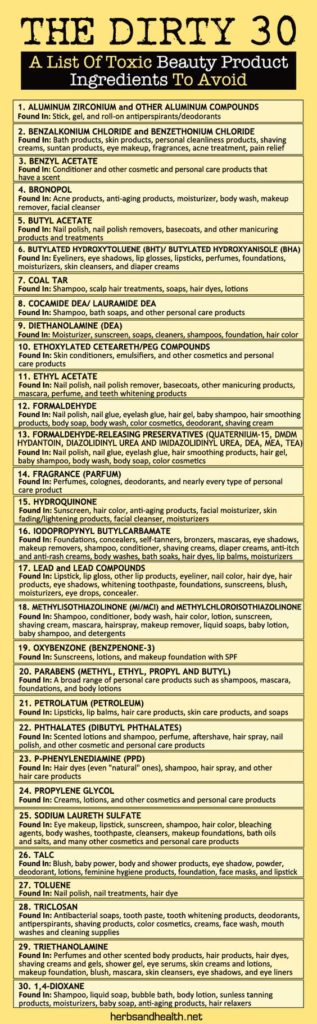
That’s where the Dirty 30 list comes in. It highlights 30 commonly used cosmetic ingredients that consumers may want to avoid when building a safer, cleaner beauty routine. Whether you’re passionate about non-toxic skincare, managing sensitive skin, or simply want to understand what’s inside your products, this guide will walk you through everything you need to know.
Why Avoid Toxic Beauty Ingredients?
Most ingredients on the Dirty 30 list are used because they’re cheap, effective, and widely available. But they come with potential downsides:
- Hormone disruption (endocrine interference)
- Skin allergies & irritations
- Respiratory issues
- Long-term safety concerns
- Environmental impact
Not all chemicals are bad—but many on this list have safer alternatives. Understanding them helps you make more informed choices.
The Dirty 30: Full Breakdown of Toxic Ingredients to Avoid
Below is a clear explanation of each ingredient group, where they’re commonly found, and why they raise concerns.
1. Aluminum Compounds
Found in: Antiperspirants, deodorants
Used to block sweat glands, but may cause skin irritation and sensitivity.
2. Benzalkonium Chloride & Benzethonium Chloride
Found in: Cleansers, acne treatments, shaving creams
Potential irritants for eyes, skin, and lungs.
3. Benzyl Acetate
Found in: Perfumes, conditioners
A fragrance ingredient linked to allergic reactions.
4. Bronopol
Found in: Anti-aging products, facial cleansers
Can release formaldehyde, a known irritant.
5. Butyl Acetate
Found in: Nail polish & remover
Strong solvent that can irritate skin and eyes.
6. BHT & BHA
Found in: Lipsticks, eyeliners, moisturizers
Synthetic antioxidants linked to hormone disruption.
7. Coal Tar
Found in: Anti-dandruff shampoos, scalp treatments
Considered a potential carcinogen.
8. Cocamide DEA / Lauramide DEA
Found in: Shampoos, bubble baths
Foaming agents that may form harmful byproducts.
9. Diethanolamine (DEA)
Found in: Moisturizers, soaps, sunscreens
Can react with nitrites to form carcinogenic nitrosamines.
10. Ethoxylated Compounds (PEGs)
Found in: Makeup, lotions, cleansers
May be contaminated with 1,4-dioxane if not purified.
11. Ethyl Acetate
Found in: Nail products, perfumes
A harsh solvent that evaporates into the air as VOCs.
12. Formaldehyde
Found in: Hair straightening products, nail hardeners
A health concern and known irritant.
13. Formaldehyde-Releasing Preservatives
Includes: DMDM hydantoin, Quaternium-15
Slowly release formaldehyde over time.
14. Fragrance (Parfum)
Found in: Almost all scented products
A mixture of hundreds of undisclosed chemicals, often linked to allergies.
15. Hydroquinone
Found in: Skin lightening creams
Effective but potentially irritating with long-term use.
16. Iodopropynyl Butylcarbamate
Found in: Lotions, makeup, shampoos
A preservative that may irritate skin, especially near the eyes.
17. Lead & Lead Compounds
Found in: Lipsticks, eyeliners, hair dyes
Lead is toxic even at tiny amounts.
18. Methylisothiazolinone (MI/MCI)
Found in: Baby wipes, shampoos, creams
A leading cause of contact dermatitis.
19. Oxybenzone
Found in: Sunscreens
Possible endocrine disruptor and coral reef toxicant.
20. Parabens (Methyl, Propyl, Ethyl, Butyl)
Found in: Lotions, makeup, shampoos
Preservatives that may mimic estrogen in the body.
21. Petrolatum (Petroleum Jelly)
Found in: Lip balms, creams
Safe only when fully refined—quality varies.
22. Phthalates
Often hidden under the word “fragrance.”
Linked with reproductive and hormonal concerns.
23. P-Phenylenediamine (PPD)
Found in: Hair dye
Can trigger strong skin reactions.
24. Propylene Glycol
Found in: Lotions, creams
A penetration enhancer that may irritate sensitive skin.
25. Sodium Laureth Sulfate (SLES)
Found in: Shampoos, cleansers
Foaming agent associated with dryness and irritation.
26. Talc
Found in: Baby powder, foundations
Contamination with asbestos is the main concern.
27. Toluene
Found in: Nail polish
A solvent that affects the nervous system when inhaled.
28. Triclosan
Found in: Antibacterial soaps
Environmental pollutant and possible hormone disruptor.
29. Triethanolamine (TEA)
Found in: Fragrances, shaving creams
Can form nitrosamines in certain conditions.
30. 1,4-Dioxane
Not listed on labels but appears as a contaminant in many foaming products.
How to Build a Clean, Safer Beauty Routine
Switching away from these chemicals doesn’t mean sacrificing performance. Here’s how to make cleaner choices:
✔ Read ingredient labels
Recognize the major red flags like “parfum,” parabens, SLS, or DEA.
✔ Choose transparent brands
Brands that fully list ingredients and avoid hidden fragrance mixtures.
✔ Opt for fragrance-free when possible
Most reactions come from synthetic scents.
✔ Use EWG or ThinkDirty apps
These provide instant toxicity ratings for thousands of products.
✔ Change gradually
You don’t need to throw everything away—swap products as they run out.
Safe & Clean Alternatives to Look For
These ingredients are gentler and safer:
- Essential oils (in small amounts)
- Natural plant butters: shea, cocoa, mango
- Seed oils: jojoba, rosehip, argan
- Coco-glucoside (gentle cleanser)
- Zinc oxide (safer sunscreen)
- Vitamin E (tocopherol)
- Aloe vera
- Glycerin
- Hyaluronic acid
Final Thoughts: Small Choices Make a Big Difference
The Dirty 30 list isn’t about fear—it’s about empowerment. Modern consumers deserve to know what’s in their beauty products. By learning which ingredients to avoid and choosing safer alternatives, you can support:
✨ Your long-term health
✨ Healthier skin
✨ A cleaner environment
✨ More ethical brands
Switching to a low-tox lifestyle is a journey, not a race. Even one product swap at a time makes a difference.