
Quick Medical Summary: Acute appendicitis is a life-threatening surgical emergency characterized by luminal obstruction of the vermiform appendix, rapid bacterial proliferation, ischemia, and risk of transmural perforation within 24 to 72 hours. The diagnostic hallmark is visceral periumbilical dull aching migrating over 6 to 12 hours to McBurney’s point in the right lower quadrant, coupled with somatic peritoneal signs: cough-induced guarding, rebound tenderness (Blumberg’s sign), and Rovsing’s sign. Never apply heating pads, administer laxatives, or give solid foods/pain relievers prior to emergency medical imaging (CT or ultrasonography). Call 911 or proceed immediately to the nearest Emergency Department for migrating lower right abdominal pain.
Few acute medical conditions develop as swiftly or carry as high a risk of rapid deterioration as acute appendicitis. It often starts innocently enough—a dull, nagging bellyache that feels like trapped gas or mild indigestion. But within hours, an inflamed appendix can transform into a life-threatening surgical emergency.
Every year, more than 300,000 Americans require urgent hospital intervention for appendicitis. If left untreated, an inflamed appendix can perforate or rupture within 24 to 72 hours of symptom onset, spilling infectious bacteria into the sterile abdominal cavity and triggering life-threatening peritonitis or systemic sepsis.
When sudden stomach pain strikes, taking a “wait and see” approach can be a perilous gamble. Below is a clear, emergency triage guide detailing the hallmark pain progression of appendicitis, the 5 red-flag symptoms that mean you must head to the Emergency Room immediately, and the critical mistakes you must never make while evaluating abdominal pain.
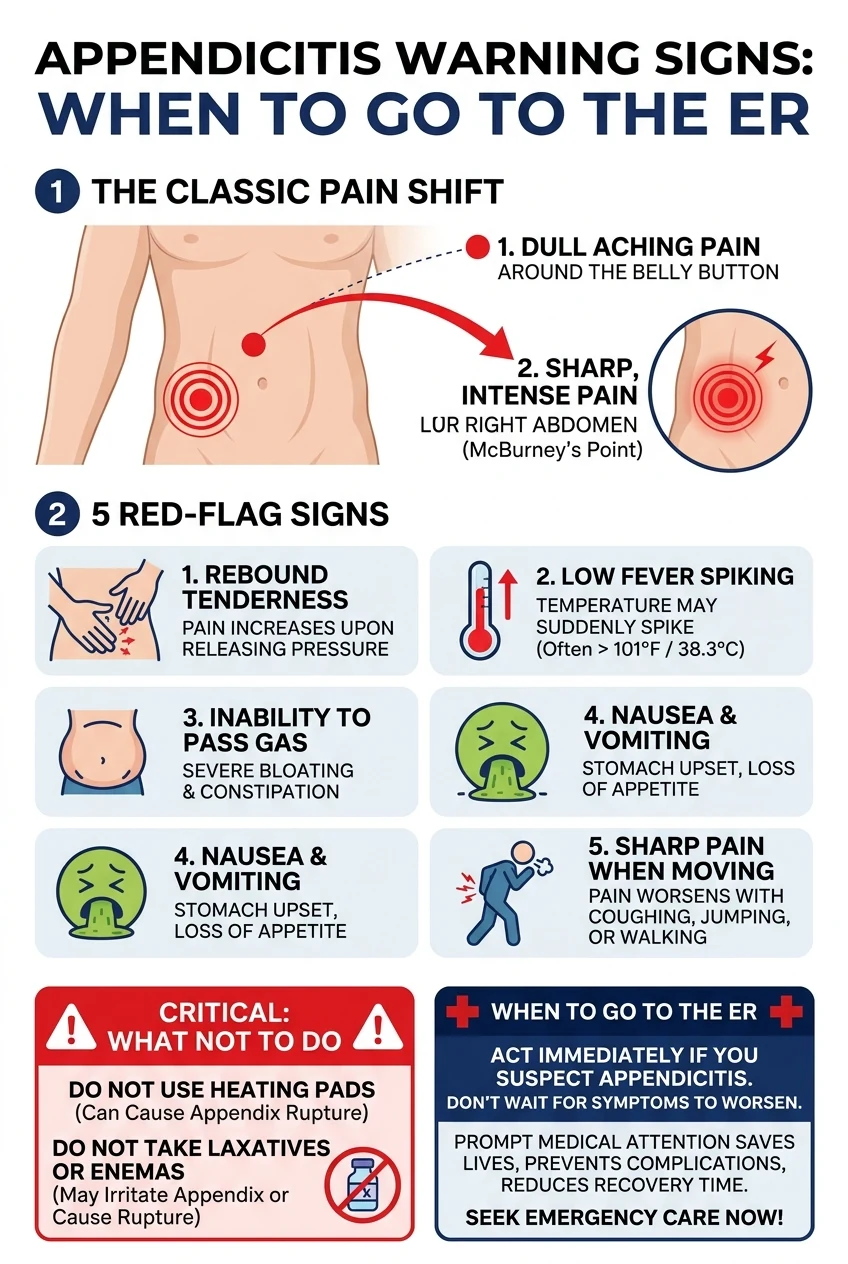
1. The Classic Hallmark: The Migrating Pain Pattern
The single most distinctive clinical clue of acute appendicitis is the way the pain evolves across anatomic dermatomes. In an authoritative clinical guideline on acute appendicitis diagnosis and the Alvarado score (PMID: 30010996) published in American Family Physician, migrating right lower quadrant pain demonstrates the highest positive likelihood ratio of any individual clinical sign.
- Phase 1 (Hours 1 to 6) — The Dull Navel Ache: The appendix is a small, finger-shaped pouch attached to the cecum at the beginning of the large intestine. When its opening becomes blocked by hardened stool (fecalith), swollen lymphoid tissue, or infection, the organ begins to swell. Because the internal visceral nerves cannot pinpoint exact locations, the brain perceives this early distension as a vague, dull, cramping ache centered directly around or just above the belly button (navel).
- Phase 2 (Hours 6 to 24) — The Migration to McBurney’s Point: As inflammation worsens, the swollen appendix begins to physically rub against the parietal peritoneum—the nerve-dense membrane lining the inside of your abdominal wall. At this point, the pain abruptly shifts from a vague central ache to a sharp, intense, localized agony in the Lower Right Quadrant of the abdomen (a specific spot known medically as McBurney’s Point, located approximately two-thirds of the distance from the navel to the right hip bone).
If your abdominal discomfort began around the navel and has steadily shifted to the right lower quadrant, do not wait to see if it improves. While atypical presentations frequently occur in elderly patients and young children (whose early complaints of stomach ache may mimic routine gastroenteritis explored in our guide on natural remedies for kids suffering from nausea), this progressive migration demands immediate professional evaluation.
2. The 5 Red-Flag Signs You Need the ER Immediately
While lower right abdominal pain is the primary indicator, acute appendicitis is almost always accompanied by a cluster of distinct physiological warning signs:
1. Pain Exacerbated by Any Sudden Movement
Inflammation of the abdominal lining makes surrounding tissues exquisitely sensitive to mechanical vibration. People with active appendicitis often find that coughing, laughing, sneezing, walking, or riding in a car over speed bumps causes agonizing jolts of pain in the lower right side. Many patients naturally adopt a defensive fetal posture, curling their right knee up toward their chest to relieve abdominal tension.
2. Rebound Tenderness (Blumberg’s Sign)
Rebound tenderness is a classic physical exam finding. When gentle downward pressure is applied to the lower right abdomen, the pain is uncomfortable—but when the hand is abruptly released, the sudden snapback of the peritoneal wall causes an intense, sharp spike of excruciating pain. (Note: Do not repeatedly press deeply on an inflamed belly at home, as excessive force can increase rupture risks).
3. Low-Grade Fever That Suddenly Spikes
Appendicitis typically begins with a modest low-grade fever between 99.5°F and 100.5°F (37.5°C – 38.1°C) accompanied by general chills. However, if that low-grade fever suddenly jumps past 101.5°F (38.6°C), it strongly suggests that the appendix has either developed micro-perforations or fully ruptured, releasing inflammatory toxins into the bloodstream.
4. Inability to Pass Gas & Severe Abdominal Distension
Because the appendix sits directly against the cecum, severe localized inflammation triggers a protective reflex called paralytic ileus—your intestines temporarily halt their normal rhythmic contractions. Patients frequently feel as though they have enormous amounts of trapped gas that they simply cannot pass. This is often accompanied by stubborn constipation or, less frequently, small bouts of mucus-laden diarrhea.
5. Sudden Anorexia & Persistent Nausea (“The Hamburger Sign”)
Nearly 90% of individuals with acute appendicitis experience a total and abrupt loss of appetite (anorexia). ER doctors often test this informally with “The Hamburger Sign”: if a hungry patient with stomach pain is offered their all-time favorite meal and recoils in nausea, appendicitis is high on the differential diagnosis. Nausea and vomiting typically follow shortly after the pain begins.
3. Appendicitis vs. Gas vs. Food Poisoning: How to Tell
Because digestive complaints are common, people frequently delay emergency care by convincing themselves they simply have gas or ate bad food. Here is how emergency doctors distinguish appendicitis from common mimics:
| Feature | Acute Appendicitis | Trapped Gas / Indigestion | Food Poisoning / Gastroenteritis |
|---|---|---|---|
| Pain Location | Starts near navel; migrates firmly to lower right | Diffuse, generalized, moves around entire belly | Cramping across entire upper or middle abdomen |
| Effect of Passing Gas | No relief; unable to pass gas or stool | Immediate noticeable relief upon passing gas | Temporary cramp relief following bowel movement |
| Symptom Sequence | Pain begins FIRST, followed later by vomiting | Bloating and rumbling without vomiting | Vomiting and watery diarrhea begin FIRST |
| Movement Sensitivity | Coughing or walking causes agonizing jolt | Walking helps move gas and feels better | Uncomfortable, but movement does not trigger sharp stabbing |
| Fever Pattern | Low fever that climbs steadily over 24 hours | No fever | Occasional high fever accompanying sudden viral chills |
4. CRITICAL: 4 Dangerous Mistakes You Must NEVER Make
When someone is suffering from acute, undiagnosed abdominal pain, well-intentioned home remedies can turn catastrophic. If you suspect appendicitis, avoid these four common pitfalls:
- DO NOT Apply a Heating Pad or Hot Water Bottle: While warmth soothes everyday muscle tension or menstrual cramps, applying external heat to an inflamed appendix dilates blood vessels, increases internal organ pressure, and can accelerate appendix rupture within minutes.
- DO NOT Take Laxatives, Enemas, or Harsh Stool Softeners: Assuming the pain is just constipation and taking chemical laxatives stimulates vigorous intestinal contractions. This sudden surge in bowel pressure can rupture an inflamed appendix wall.
- DO NOT Mask Symptoms with Heavy Painkillers: Taking strong prescription narcotics or high-dose NSAIDs before a doctor examines you can mask vital abdominal signs (like muscle guarding and rebound tenderness), leading to dangerous diagnostic delays.
- DO NOT Eat or Drink Anything (NPO Rule): If surgery is required, having food or liquids in your stomach increases the risk of pulmonary aspiration under general anesthesia, delaying the surgical team from taking you into the operating room immediately.
5. What Happens at the ER and Modern Surgical Care
Arriving at the emergency room can feel stressful, but modern medical protocols make diagnosing and treating appendicitis swift and routine:
- Diagnostic Imaging: Physicians will order a quick blood test (checking for elevated white blood cells signaling infection) and perform an abdominal ultrasound or low-dose contrast CT scan, which visualizes the swollen appendix with greater than 95% accuracy. While the landmark CODA randomized trial in the New England Journal of Medicine (PMID: 33017106) demonstrated that antibiotic therapy can be considered for select uncomplicated presentations, surgical appendectomy remains the definitive standard of care to permanently eliminate perforation risks.
- Laparoscopic Appendectomy: The vast majority of appendectomies today are performed minimally invasively through three tiny keyhole incisions (each less than half an inch). A miniature camera guides surgical instruments to remove the appendix without cutting through major abdominal muscle sheets.
- Rapid Hospital Discharge: Uncomplicated laparoscopic procedures typically take under 45 minutes, and most patients are walking within hours and discharged home the following day.
6. Post-Surgery Recovery & Gut Microbiome Rehabilitation
Following an appendectomy, patients receive IV antibiotics to prevent post-surgical infection. While essential, antibiotics temporarily deplete beneficial intestinal microflora. Once home, supporting your body’s restorative processes accelerates full recovery:
- Relieving Laparoscopic Gas Discomfort: Surgeons inflate the abdominal cavity with harmless carbon dioxide gas during laparoscopy. Some residual gas can irritate the phrenic nerve, causing mild referred shoulder pain for 48 hours. Gentle indoor walking and warm sips of peppermint or ginger tea help naturally disperse this gas.
- Repopulating Beneficial Gut Flora: Starting a diverse, broad-spectrum probiotic supplement (featuring Lactobacillus and Bifidobacterium strains) 48 hours after completing surgical antibiotics helps prevent antibiotic-associated diarrhea and restores digestive equilibrium.
- Nutrient-Dense Recovery Broths: Sipping warm bone broths supplies glycine and collagen to knit surgical incision sites while remaining effortlessly gentle on slow post-anesthesia intestines.
Recommended Post-Op Recovery & Gut Health Essentials
To support a comfortable, smooth recovery following abdominal surgery and restore your digestive vitality, here are three highly rated essentials:
Garden of Life Dr. Formulated Probiotics (50B CFU)
Doctor-formulated broad-spectrum daily probiotic with 16 diverse strains and prebiotic fiber. Crucial for restoring healthy gut microbiome diversity following surgical antibiotics.
Post-Surgery Contoured Abdominal Splinting Pillow
Features a supportive pocket for gel packs and provides gentle counter-pressure when coughing, laughing, or riding in the car after laparoscopic abdominal surgery.
Traditional Medicinals Organic Peppermint Herbal Tea
Pharmacopoeial-grade organic peppermint leaf. A soothing, caffeine-free herbal infusion that naturally eases post-laparoscopic trapped gas and digestive spasms.
Related Clinical & Digestive Guides
- Post-Op Microbiome Recovery: The Complexity of the Gut: Microbiome, Mucosal Immunity & Digestion
- Pediatric Digestive Emergencies: Natural Remedies for Kids Suffering from Nausea & Upset Stomach
- Abdominal Pain Differential: What Is IBS? Myths, Facts, Low-FODMAP Diet & Natural Therapies
- Bowel Motility & Avoidance: Natural Remedies for Constipation: 7 Clinically Proven Ways to Restore Regularity
- Hepatic Antibiotic Clearance: Liver Health Essentials: Phase I & II Detox Science, Silymarin & Protocols
Frequently Asked Questions
What happens if the pain suddenly disappears completely?
Beware: If agonizing lower right abdominal pain suddenly vanishes into peaceful relief, do not assume you are cured. A sudden, abrupt cessation of pain often means the appendix has officially ruptured, relieving the pressurized stretch inside the organ. Within hours, however, generalized peritonitis will set in with high fever and severe whole-belly rigidity. Seek emergency hospital care immediately.
Can appendicitis ever be treated with antibiotics instead of surgery?
In carefully selected clinical trial settings with uncomplicated, non-perforated appendicitis, intravenous antibiotic therapy alone has succeeded in resolving early inflammation. However, roughly 25% to 30% of patients treated with antibiotics alone experience recurrent appendicitis within one year, which is why laparoscopic appendectomy remains the definitive global standard of care.
How long does full recovery take after an appendectomy?
Following minimally invasive laparoscopic surgery, most individuals can return to desk work and light routine activities within 1 to 2 weeks. Full clearance for heavy lifting, contact sports, and vigorous abdominal workouts is typically granted at the 4-to-6 week postoperative checkup.
Medical Emergency Disclaimer: Acute appendicitis is a life-threatening surgical emergency. If you or someone in your care is experiencing severe, migrating, or progressive abdominal pain, especially accompanied by fever, vomiting, or movement sensitivity, do not delay. Call emergency services (911) or proceed immediately to the nearest hospital Emergency Room.