
When a routine medical visit takes an unexpected turn, the emotional impact on a family is profound. For parents of teenagers diagnosed with severe, unexpected neurological illnesses, such as acute transverse myelitis or Guillain-Barré syndrome, the journey to find answers, support, and accountability can be overwhelming. Few topics evoke deeper emotions than reports linking these life-altering conditions to routine vaccinations like Gardasil (the HPV vaccine).
In the age of social media, tragic individual medical stories often spread rapidly without critical scientific context. Conversely, official public health messaging sometimes dismisses parental fears as mere statistical insignificance. Between these two extremes lies the nuanced truth that every parent and patient deserves: an objective, compassionate, and evidence-based examination of how the HPV vaccine works, what medical surveillance reveals about rare neurological adverse events, and what to do if unexpected symptoms arise.
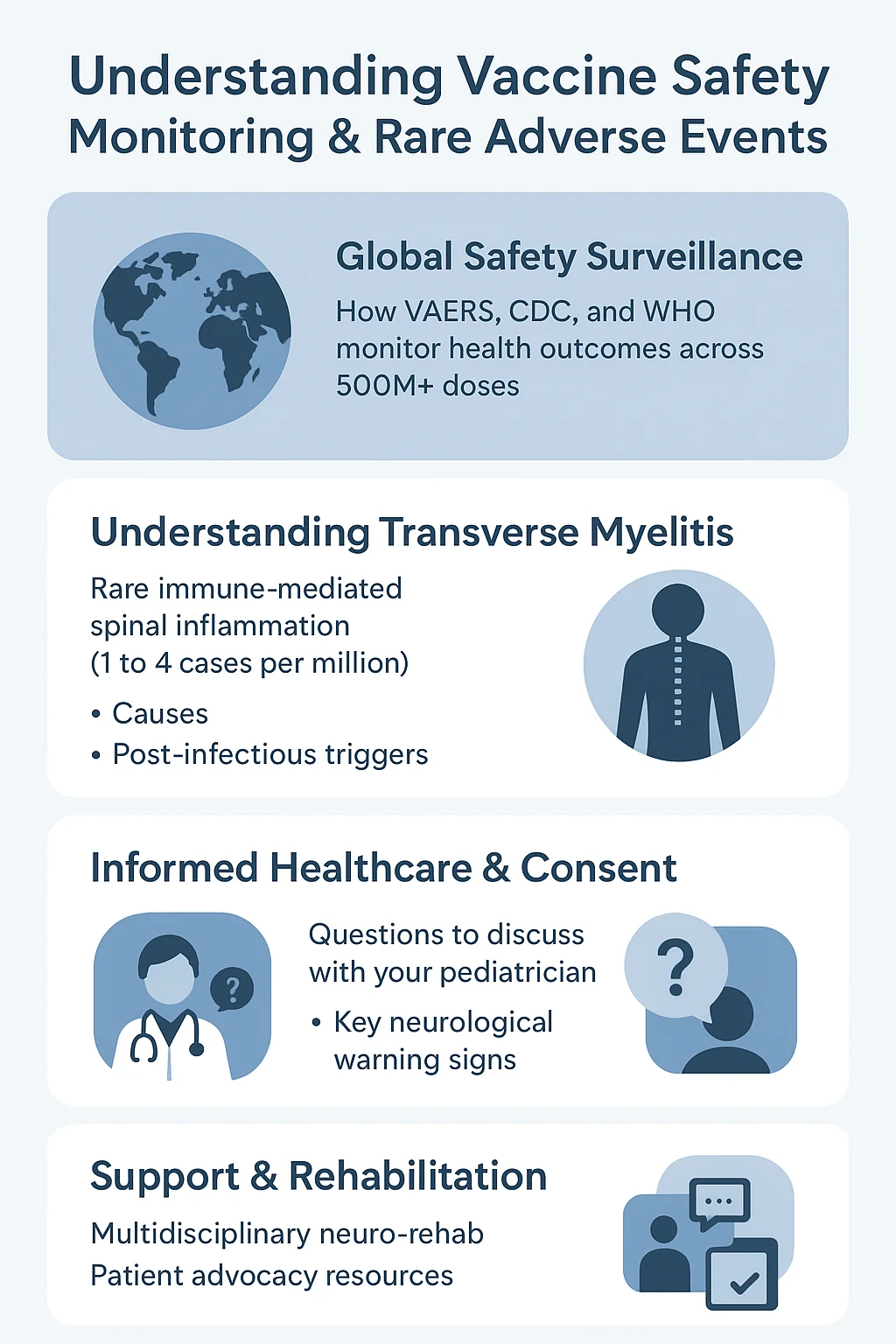
📋 Clinical Summary & Pharmacovigilance Key Takeaways
- Transverse Myelitis Pathology: A severe focal inflammatory demyelination of the spinal cord that damages myelin sheaths, disrupting motor, sensory, and autonomic signaling below the affected spinal segment.
- Epidemiological Safety Data: Global health surveillance across over 500 million distributed doses confirms that autoimmune demyelinating events following HPV vaccination occur at rates comparable to expected background population baselines (1 to 8 cases per million annually).
- Reporting System Realities: The Vaccine Adverse Event Reporting System (VAERS) is a passive, hypothesis-generating safety net that tracks temporal correlations; formal causation requires rigorous active-surveillance epidemiological verification.
- Comprehensive Rehabilitation: Acute post-inflammatory recovery combines acute immunomodulatory therapy (high-dose intravenous methylprednisolone, plasma exchange) with targeted neuro-rehabilitation and neurotrophic nutrient support.
1. What is Transverse Myelitis?
To understand the debate surrounding rare post-immunization complications, one must first understand the condition central to many high-profile reports: transverse myelitis (TM).
Transverse myelitis is a rare neurological disorder caused by acute inflammation across the width of one or more segments of the spinal cord. The spinal cord acts as the central information superhighway between the brain and the rest of the body. When inflammation attacks the protective fatty sheath (myelin) surrounding spinal nerve fibers, communication is interrupted, resulting in:
- Rapidly Progressing Weakness: Heaviness or loss of movement in the legs, which can in severe cases advance to paralysis affecting the lower extremities or extending upward toward the trunk and arms.
- Sensory Abnormalities: Numbness, burning sensations, or a distinctive “tight band-like” constriction around the chest or abdomen.
- Autonomic & Bowel Dysfunction: Sudden urinary retention, loss of bladder control, or digestive paralysis.
According to the National Institute of Neurological Disorders and Stroke (NINDS), transverse myelitis has a natural baseline incidence of approximately 1.34 to 4.6 cases per million people per year. Crucially, the majority of cases are post-infectious, triggered when an immune response launched against a common cold, enterovirus, flu, or bacterial infection misdirects its antibodies toward the body’s own spinal tissues.
At the histopathological level, acute transverse myelitis is characterized by perivenous lymphocytic infiltration, macrophage activation, and immune-mediated destruction of myelin basic protein surrounding spinal axons. Rigorous neurological reviews published in Autoimmunity Reviews (PubMed PMID: 24005878) highlight that acute transverse myelitis frequently occurs following systemic viral or bacterial infections through molecular mimicry, where cross-reactive antibodies mistakenly target self-myelin antigens on oligodendrocytes. This focal swelling disrupts ascending sensory pathways and descending corticospinal motor tracts, precipitating rapid motor weakness, sensory paresthesias, and sphincter dysfunction.
2. What Does Global Data Show About the HPV Vaccine?
The Human Papillomavirus (HPV) vaccine was developed to prevent high-risk viral strains responsible for over 90% of cervical cancers, as well as anal, throat, and penile malignancies. Since its initial approval in 2006, more than 500 million doses of HPV vaccines (including Gardasil and Gardasil 9) have been administered globally.
Because the vaccine is administered primarily to adolescents, an age bracket during which autoimmune and neurological conditions often first manifest, independent health agencies worldwide have tracked its safety with unprecedented scrutiny:
| Health Agency / Study | Population Studied | Key Findings on Neurological Safety |
|---|---|---|
| U.S. CDC & FDA (VSD) | Over 2.8 million doses monitored | No statistically significant increased risk of transverse myelitis, multiple sclerosis, or Guillain-Barré syndrome compared to unvaccinated baseline controls. |
| European Medicines Agency (EMA) | Over 80 million doses in Europe | Comprehensive safety review confirmed that benefits in cancer prevention substantially outweigh risks, with no causal link found to complex regional pain or autonomic dysfunction. |
| Nordic Cohort Study (BMJ) | Nearly 1 million girls in Sweden & Denmark | Investigated 53 different autoimmune and neurological endpoints; found no evidence of increased incidence of spinal demyelinating diseases. |
| WHO Global Advisory Committee (GACVS) | Worldwide ongoing surveillance | Consistently classifies the HPV vaccine as having an extremely robust global safety profile. |
Massive population-based cohort investigations evaluating post-licensure pharmacovigilance provide essential epidemiological perspective. In a landmark multi-national registry study published in the Journal of Internal Medicine (PubMed PMID: 28734861) monitoring nearly 4 million female vaccine recipients, researchers evaluated the incidence of 45 pre-defined autoimmune conditions, including transverse myelitis, multiple sclerosis, and Guillain-Barré syndrome. The comprehensive analysis confirmed no statistically elevated relative risk between vaccinated and unvaccinated cohorts, establishing that background autoimmune incidences naturally coincide with widespread adolescent immunization schedules.
3. Understanding VAERS: Correlation vs. Causation
When news articles report that an adverse event was “reported to the government,” they are usually referencing the Vaccine Adverse Event Reporting System (VAERS), co-managed by the CDC and FDA. Understanding how VAERS works is vital for interpreting medical news accurately:
- VAERS is an Open Early-Warning Signal System: Anyone, doctors, parents, patients, or manufacturers, can file a report if a medical problem occurs after vaccination, regardless of whether the vaccine caused it.
- Temporal Coincidence Does Not Equal Causation: Because millions of teenagers receive vaccines each month, background illnesses (including rare autoimmune disorders) will inevitably happen in the days or weeks following a shot by statistical coincidence alone.
- How True Signals Are Identified: When VAERS detects an unexpected cluster of a specific symptom, epidemiologists immediately transition to controlled studies (like the Vaccine Safety Datalink) to evaluate whether the rate in vaccinated individuals exceeds the normal baseline background rate.
4. When Tragedy Strikes: The Support & Legal Safety Net
Regardless of whether a medical condition is definitively proven to stem from a vaccine or represents an unfortunate coincidental autoimmune onset, the financial and physical toll on families is immense. In the United States, lawmakers established the National Vaccine Injury Compensation Program (VICP) in 1986 under the National Childhood Vaccine Injury Act.
The VICP operates as a “no-fault” administrative alternative to standard court litigation:
- It is funded by an 75-cent excise tax on each vaccine dose.
- Families do not need to prove that a pharmaceutical manufacturer was negligent; they only need to demonstrate a temporal and biological plausibility meeting federal court standards.
- The program has awarded financial support covering past and future medical care, home accessibility modifications, and physical therapy for individuals experiencing severe post-immunization complications.
5. Early Red-Flag Neurological Symptoms to Watch For
Whenever a teenager experiences an acute illness or receives any medical procedure, prompt recognition of neurological warning signs is critical. Early intervention with high-dose intravenous corticosteroids, plasma exchange (plasmapheresis), or IVIG can dramatically alter the course of spinal cord inflammation:
- Progressive Symmetrical Weakness: Inability to bear weight, stumbling, dropping objects, or feeling as though legs are made of heavy lead.
- Ascending Numbness or “Pins and Needles”: Tingling that starts in the toes or fingertips and steadily creeps upward toward the torso over hours or days.
- Sudden Bladder or Bowel Changes: Inability to urinate despite a full bladder, or unexpected incontinence.
- Severe Mid-Back Pain: Sharp, localized spinal ache radiating outward like a tight band around the ribs.
If any of these signs appear, immediate evaluation at an emergency department equipped with MRI neuro-imaging is essential.
6. Integrative Rehabilitation & Nerve Recovery
Recovery from acute transverse myelitis is often a long, courageous journey requiring a dedicated multidisciplinary care team. Neuroplasticity, the nervous system’s ability to rewire and build new pathways around damaged spinal tracts, is strongest when rehabilitation begins promptly:
- Targeted Physical & Occupational Rehabilitation: Daily functional electrical stimulation (FES), active-assisted gait training, and reciprocal motor retraining stimulate dormant motor pathways. For clinical principles of neuromuscular rehabilitation and peripheral nerve decompression, explore our guide on nerve compression, physical therapy, and joint rehabilitation.
- Spinal Alignment & Biomechanical Support: Ensuring precise spinal alignment and pelvic symmetry minimizes compensatory muscular spasm in unaffected regions; review our clinical protocols for spinal care, decompression, and back pain relief.
- Neurotrophic Micronutrient Repletion: High-dose methylcobalamin (active B12), benfotiamine (fat-soluble B1), alpha-lipoic acid, and vitamin D3 nourish oligodendrocyte regeneration and axonal repair; review our comprehensive checklist on which vitamins you may be missing for optimal nerve function.
- Gentle Somatic & Restorative Movement: Incorporating guided somatic breathwork, restorative stretching, and adapted mindful movement downregulates sympathetic autonomic distress; learn more in our guide on yoga and natural physical recovery remedies.
- Aquatic Therapy & Gravity-Assisted Stepping: Warm water immersion relieves gravitational compression, enabling recovering neural circuits to trigger reciprocal stepping reflexes safely.
- Functional Neuromodulation & Acupuncture: Targeted electro-acupuncture and transcutaneous electrical nerve stimulation (TENS) provide sensory feedback to spinal dorsal root ganglia, mitigating intractable central neuropathic burning.
Neuroplasticity & Long-Term Myelin Recovery Mechanisms
Long-term recovery from central nervous system demyelination relies fundamentally on two biological phenomena: remyelination by oligodendrocyte precursor cells (OPCs) and adaptive neuroplasticity. When spinal cord tracts undergo acute demyelination, surviving axonal pathways can form novel synaptic collateral sprouts across unaffected grey matter interneurons. To maximize this intrinsic regenerative capacity, clinical rehabilitation guidelines emphasize high-repetition, task-specific motor practice paired with adequate caloric and nutrient support.
Mitochondrial energy production is the primary metabolic engine powering axonal repolarization. Supporting cellular bioenergetics with coenzyme Q10, acetyl-L-carnitine, and magnesium glycinate helps overcome the chronic energy crisis that characterizes demyelinated nerve fibers. Families navigating recovery should coordinate closely with board-certified physical medicine and rehabilitation (PM&R) physiatrists and licensed physical therapists who specialize in spinal cord injury rehabilitation.
7. Recommended Support & Mobility Essentials
For individuals and caregivers navigating spinal recovery, physical rehabilitation, and nervous system support, here are three highly rated essentials:
Nordic Naturals essential Omega (1280 mg)
High-concentration, third-party tested EPA & DHA from wild Arctic fish. Clinically supported for maintaining healthy neurological response and modulating systemic inflammation.
TheraBand Professional Latex Resistance Bands
Essential physical therapy tool for progressive resistance training, motor control recovery, and gentle stretching during home neuro-rehab sessions.
ComfiLife Premium Ergonomic Memory Foam Cushion
Provides contoured coccyx and spinal decompression for individuals spending extended hours in chairs or mobility aids, preventing pressure sores and fatigue.
Related Clinical Rehabilitation & Neurological Guides
- Nerve Health & Compression: Physical Therapy, Ergonomics & Rehabilitation
- Spinal Care & Back Pain Relief: Decompression, Posture & Core Science
- Which Vitamins Are You Missing? Neuroprotective Micronutrients & Recovery
- Yoga & Natural Healing: Somatic Restoration, Circulation & Recovery
- QL Muscle Release: Relieving Deep Lumbar Tension & Postural Imbalance
Frequently Asked Questions
Can vaccines cause transverse myelitis?
While isolated case reports of transverse myelitis occurring after various vaccinations (including HPV, flu, and COVID-19) exist in medical literature, massive epidemiological surveillance studies have not found a statistically significant increase in transverse myelitis rates above expected natural background rates.
What is the typical recovery timeline for transverse myelitis?
Recovery varies significantly by individual. Approximately one-third of patients achieve full recovery with minimal lasting deficits, one-third experience moderate neurological recovery, and one-third face long-term mobility challenges. Most recovery occurs within the first 3 to 12 months, though improvements can continue for several years with dedicated physical therapy.
Where can affected families find support?
Non-profit advocacy groups such as the Siegel Rare Neuroimmune Association (SRNA) offer specialized peer support networks, access to expert medical centers, and rehabilitation toolkits for families navigating rare spinal cord and autoimmune disorders.
Medical Disclaimer: This article is intended for educational and informative purposes only and does not provide individual medical diagnosis or legal counsel. If you or a family member experience sudden neurological symptoms, seek urgent medical evaluation at an emergency care center immediately.