
Clinical Nutritional Economics & Satiety Summary
Clinical Status: The widespread assertion that eating for fat loss is prohibitively expensive is a nutritional fallacy rooted in the marketing of ultra-processed “diet” specialty items. While branded low-carb snacks, boutique meal deliveries, and synthetic isolates carry exorbitant markups, foundational agricultural commodities provide superior micronutrient density and satiety per dollar.
Economic Metabolic Principles: Prioritizing budget-friendly whole foods, such as whole eggs, dried legumes, frozen vegetables, and starchy tubers, allows individuals to achieve optimal protein thresholds (1.6–2.2 g/kg) and high viscous fiber intakes for under $6.50 per day, outperforming expensive commercial weight-loss products.
The “Healthy Eating Is Expensive” Myth: An Economic Deconstruction
One of the most frequent rationalizations for abandoning nutritional improvements is the pervasive belief that eating for fat loss requires a luxury budget. This misconception is aggressively reinforced by modern commercial marketing, which equates healthy living with expensive organic superfood powders, single-serving gluten-free baked goods, and specialized “keto” packaged meals.
When health seekers fill their shopping carts with ultra-processed convenience diet foods, their grocery bills inevitably skyrocket. A box of four boutique protein bars often costs $12 to $15, delivering a meager 80 grams of protein bound with synthetic sugar alcohols. In contrast, that same $12 can purchase two dozen pasture-raised eggs and two pounds of dry green lentils, yielding over 250 grams of complete bioavailable protein and 120 grams of prebiotic dietary fiber.
Agricultural economic analyses consistently demonstrate that minimally processed whole food commodities are significantly cheaper per calorie of bioavailable micronutrients than modern convenience foods. The true financial burden does not stem from whole foods, but from outsourcing culinary preparation to industrial food manufacturers.
To understand which unprocessed staples provide the highest physiological fullness per unit of energy, explore our clinical evaluation of the 9 best high-satiety foods to eat when dieting.
Protein Economics: Maximizing Bioavailable Leucine per Dollar
During caloric restriction, adequate protein intake is non-negotiable. Consuming 1.6 to 2.2 grams of protein per kilogram of body weight preserves lean skeletal muscle mass, maintains resting metabolic rate, and stimulates satiety peptides (PYY, GLP-1). However, protein is typically the most expensive macronutrient.
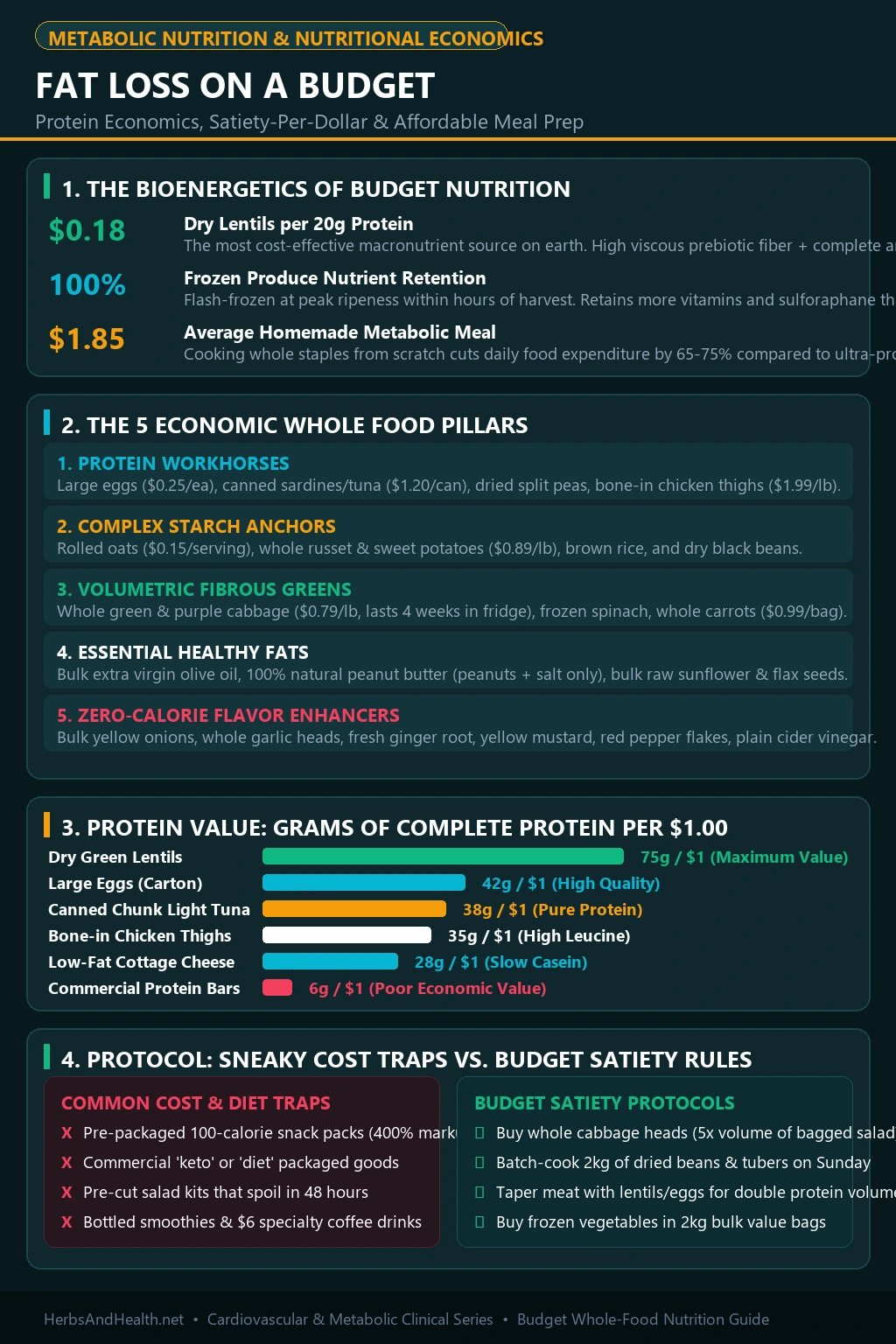
To achieve optimal amino acid intake on a limited budget, smart dieters evaluate foods through the metric of Grams of Protein per Dollar ($1.00):
1. Dried Green Lentils & Split Peas (~75g Protein per $1.00)
Dried pulses represent the undisputed champions of nutritional economics. A one-pound bag of dried lentils costs approximately $1.50 and delivers 110 grams of protein alongside 60 grams of soluble viscous fiber. When combined with whole grains, lentils supply a complete essential amino acid profile while producing the clinical second-meal effect, blunting hunger for hours.
2. Large Whole Eggs (~42g Protein per $1.00)
At roughly $3.00 to $3.50 per carton of twelve, eggs deliver complete protein with a biological value of 100 for approximately $0.25 to $0.29 per egg. The yolk provides dense choline, lutein, and fat-soluble vitamins that support liver metabolism and cellular health.
3. Canned Chunk Light Tuna & Wild Sardines (~38g Protein per $1.00)
Canned pelagic fish are nutritional powerhouses packed with pure protein and anti-inflammatory marine omega-3 fatty acids (EPA/DHA). A $1.20 can of chunk light tuna packed in water provides 30 grams of pure, lean protein with virtually zero carbohydrates or fat.
4. Bone-In, Skin-On Poultry Thighs & Quarters (~35g Protein per $1.00)
Boneless chicken breasts often command premium prices ($4.50–$6.00/lb), but bone-in thighs or leg quarters routinely sell for $1.49 to $1.99/lb. Simply removing the skin after cooking yields lean, high-leucine protein. Additionally, simmering the discarded bones produces mineral-rich homemade bone broth at zero additional expense.
Volumetric Carbohydrate & Fiber Anchors: High Satiety, Low Cost
Achieving sustained fat loss requires foods that deliver massive gastric distension for minimal caloric investment. Stacking your plate with economical complex starches and fibrous vegetables keeps your stomach mechanically full without breaking your budget:
1. Old-Fashioned Rolled Oats ($0.15 per Serving)
A large canister of plain rolled oats costs under $4.00 and provides 30 hearty breakfasts. Oats are rich in beta-glucan, a viscous soluble fiber that forms an unstirred gelatinous layer in the small intestine, delaying gastric emptying and stabilizing postprandial glucose curves.
2. Whole Russet & Sweet Potatoes ($0.79 to $0.99 per Pound)
Boiled potatoes hold the highest score on the Holt Satiety Index (323%). A 5-pound bag costs less than $4.00. Boiling potatoes and cooling them in the refrigerator overnight converts their digestible starches into Type-3 Resistant Starch, which nourishes colon microbes and yields appetite-suppressing short-chain fatty acids.
3. Whole Green & Purple Cabbage ($0.69 to $0.89 per Pound)
Bagged salad kits spoil within days and cost upwards of $4.00 for two servings. In contrast, a dense, whole head of cabbage costs around $2.00, yields over ten cups of shredded greens, and remains crisp in the refrigerator for four to six weeks. Cabbage provides rich insoluble cellulose fiber and glucosinolates that support cellular antioxidant defense.
4. Flash-Frozen Broccoli & Spinach ($1.25 per 16 oz Bag)
Contrary to popular belief, commercially frozen vegetables are often more nutrient-dense than fresh produce that has spent two weeks in transit. Frozen broccoli florets provide high-density sulforaphane and volumetric bulk with zero prep waste. Structured meal composition using these ingredients is detailed in our clinical lunch and dinner meal planning guide.
The $45 Weekly Fat Loss Grocery Blueprint & Meal Framework
To demonstrate the practical application of budget dietetics, review this actual weekly grocery shopping cart and daily meal plan designed to deliver 140g protein and 35g fiber daily for under $6.50 per day:
The $45 Weekly Shopping Basket:
- 2 Cartons Large Eggs (24 eggs): $6.00
- 4 lbs Bone-In Chicken Thighs: $7.50
- 4 Cans Chunk Light Tuna in Water: $4.80
- 2 lbs Dried Green Lentils: $3.00
- 1 Large Canister Rolled Oats (42 oz): $3.80
- 5 lbs Russet Potatoes: $3.90
- 1 Large Head Green Cabbage (3 lbs): $2.20
- 2 Bags Frozen Broccoli Florets (32 oz total): $2.60
- 2 lbs Fresh Carrots: $1.80
- 1 Jar 100% Natural Peanut Butter: $2.50
- 1 Head Garlic & 3 lbs Yellow Onions: $2.80
- Total Weekly Grocery Investment: ~$40.90
Daily Meal Framework:
- Breakfast (Cost: ~$1.10): 3 scrambled eggs cooked with shredded cabbage and black pepper, served alongside 1/2 cup cooked rolled oats topped with 1 tablespoon natural peanut butter. (30g protein, 7g fiber).
- Lunch (Cost: ~$1.45): 1.5 cups simmered green lentils seasoned with sautéed garlic and onions, served over a boiled, cooled russet potato and topped with one can of tuna and lemon juice. (42g protein, 16g fiber).
- Dinner (Cost: ~$1.75): 2 roasted chicken thighs (skin removed post-cooking) seasoned with paprika, served with 2 cups of steamed frozen broccoli and roasted carrot batons. (45g protein, 8g fiber).
For structured metabolic variations of this framework, consult our thriving metabolic weight loss plans.
Economic Comparison: Whole Food Staples vs. Convenience Diet Items
Evaluate the nutritional value and cost efficiency of whole agricultural staples compared to common commercial diet foods:
| Food Item | Average Cost / Serving | Protein / Dollar | Fiber / Dollar | Satiety Rating | Economic Verdict |
|---|---|---|---|---|---|
| Dried Green Lentils | $0.18 | 75 g / $1 | 40 g / $1 | Very High (Second-Meal Effect) | essential Budget Staple |
| Large Whole Eggs | $0.26 | 42 g / $1 | 0 g | High (Choline & Leucine) | Gold-Standard Protein |
| Boiled Potatoes | $0.22 | 14 g / $1 | 18 g / $1 | Maximum (323% Holt Score) | Best Satiety Value |
| Whole Green Cabbage | $0.15 | 8 g / $1 | 25 g / $1 | Very High (Stomach Stretch) | Longest Shelf Life |
| Commercial Diet Protein Bar | $3.25 | 6 g / $1 | 3 g / $1 | Low (Rapidly Digested) | Expensive & Inefficient |
Kitchen & Meal Prep Essentials for Budget Precision
Having durable, multipurpose kitchen gear transforms budget ingredients into delicious, convenient daily meals:
OXO Good Grips Large Salad Spinner
Washes and spins dry bulk heads of cabbage, greens, and herbs in seconds. Thorough drying prevents cellular rot, tripling produce shelf life in the crisper drawer.
Cuisinart 12-Quart Stainless Steel Stockpot
Heavy-duty encapsulated base distributes heat evenly. Perfect for simmering large batches of dry legumes, boiling resistant-starch potatoes, and making homemade bone broth.
Rubbermaid Brilliance Leak-Proof Food Containers
Crystal-clear, BPA-free containers with 100% airtight latches. Keeps prepped grains, shredded cabbage, and cooked chicken fresh throughout the week without freezer burn.
Strategic Grocery Tactics: How to Outsmart Supermarket Traps
Navigating modern grocery stores requires disciplined tactics to protect your wallet and metabolic health:
- Shop the Outer Perimeter: The outer edges of supermarkets house basic agricultural commodities: fresh produce, butcher meats, and eggs. Center aisles are dominated by ultra-processed packaged items with high profit margins and low satiety indexes.
- Never Buy Single-Serving Snack Packs: Individually wrapped 100-calorie snack packs carry markups exceeding 400%. For economical craving management, make your own portable snacks using whole ingredients; review our 25 super snacks with 100 calories or less.
- Utilize Dry Bulk Spices: Bottled commercial sauces and salad dressings are loaded with cheap soybean oil and added sugars. Purchasing bulk garlic powder, cumin, smoked paprika, black pepper, and yellow mustard gives you infinite flavor variations for pennies.
- Zero-Waste Broth Protocol: Never discard vegetable scraps (onion skins, carrot tops, celery ends) or poultry bones. Store them in a freezer bag; once full, simmer them in your stockpot with water for 12 hours to produce free, mineral-rich bone broth.
Frequently Asked Questions About Budget Fat Loss
Are canned vegetables and beans as healthy as fresh ones?
Yes. Canned legumes are pressure-cooked during sealing, preserving protein and soluble fiber while deactivating lectins. For canned beans and vegetables, simply rinse them in a colander under cold water for 30 seconds to remove up to 40% of added sodium.
Do I need to buy 100% organic food to lose fat?
No. Fat loss is governed by energy balance, macronutrient distribution, and satiety hormones. Conventional produce and standard eggs deliver identical protein, fiber, and macronutrient structures at a fraction of organic prices.
How can I get adequate omega-3 fatty acids without expensive fresh salmon?
Canned sardines, chunk light tuna, and bulk whole flaxseeds or chia seeds provide abundant omega-3 fatty acids at a tiny fraction of the cost of fresh wild salmon fillets.
What is the most filling breakfast under $1.00?
Three whole scrambled eggs paired with 1/2 cup of cooked rolled oats and a dash of cinnamon. This breakfast delivers 24g of protein and 5g of beta-glucan fiber for approximately $0.85 total.
Does buying frozen meat reduce protein quality?
Not at all. Freezing halts microbial degradation while locking in complete amino acids and micronutrients. Buying family packs of frozen poultry or lean ground beef on sale is a premier money-saving strategy.
Peer-Reviewed Clinical References & Agricultural Economics
- Drewnowski, A. (2010). The cost of US foods as related to their nutritive value. American Journal of Clinical Nutrition, 92(5), 1181-1188.
- Holt, S. H., et al. (1995). A satiety index of common foods. European Journal of Clinical Nutrition, 49(9), 675-690.
- Carlson, A., & Frazão, E. (2012). Are healthy foods really more expensive? It depends on how you measure the price. USDA Economic Research Service, EIB-96.
- Darmon, N., & Drewnowski, A. (2015). Contribution of food prices and diet cost to socioeconomic disparities in diet quality and health. BMJ Open, 5(6), e007584.
- Leidy, H. J., et al. (2015). The role of protein in weight loss and maintenance. American Journal of Clinical Nutrition, 101(6), 1320S-1329S.