
If you have ever dragged yourself out of bed at 5:30 AM for an exhausting workout, only to step on the scale weeks later and see zero progress, you are definitely not alone. For decades, fitness culture has repeated the same exhausting message: if you want to burn calories and shed fat, you must spend grueling hours sweating through punishing cardio or lifting weights until your legs shake.
Here is the surprising reality of human biology: that 45-minute gym session accounts for only about 5% of your total daily calorie burn. The remaining 95% happens while you work at your desk, walk through the grocery store, digest meals, and go about your normal day.
This means you do not need to live in gym clothes to melt extra calories. By making a few effortless adjustments to your daily routine, habits requiring zero extra willpower, you can burn an extra 300 to 600 calories every single day on pure autopilot. Here is how everyday movement works and six simple lifestyle habits that supercharge your daily burn without stepping foot on a treadmill.
💡 Daily Calorie Burn at a Glance
- The Secret Weapon (NEAT): Non-Exercise Activity Thermogenesis accounts for 15% to 20% of your daily burn and is the biggest variable you can control.
- Pacing on Calls: Walking while on phone calls adds 2,000 to 4,000 daily steps and burns 150 to 200 extra calories without feeling like exercise.
- The Protein Advantage: Your body expends 20% to 30% of protein calories just during digestion, naturally boosting your metabolic expenditure.
- Post-Meal Walking: A gentle 15-minute walk after dinner flattens blood sugar spikes and burns an extra 70 calories effortlessly.
- The Compounding Effect: Burning an extra 400 calories daily equals 2,800 calories per week, nearly a full pound of fat burned every nine days.
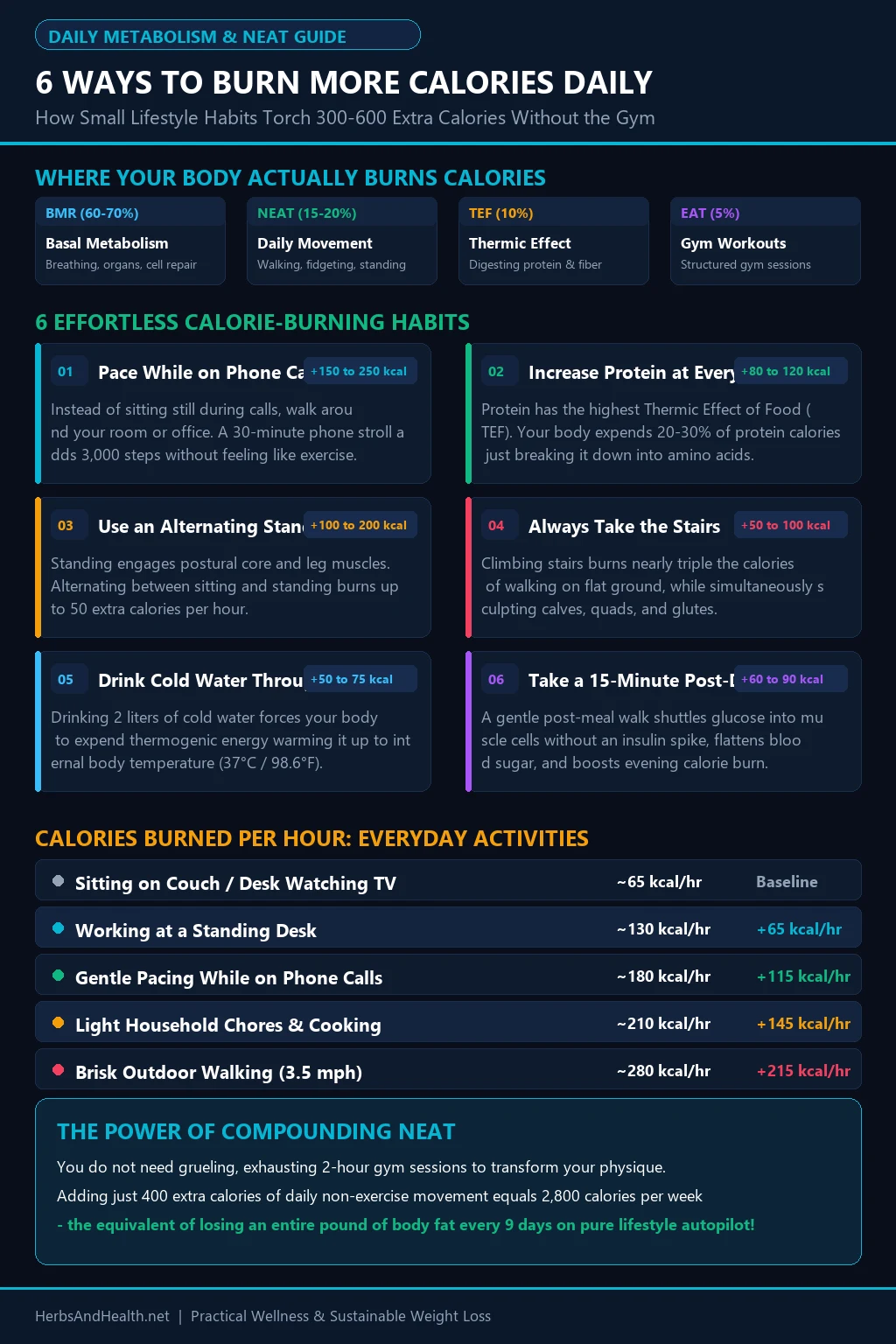
The Daily Calorie Formula: Why the Gym is Only 5% of the Equation
To understand why small lifestyle tweaks produce such dramatic results, we need to look at how your body actually burns energy throughout a 24-hour day. Scientists call this your Total Daily Energy Expenditure (TDEE), divided into four buckets:
- Basal Metabolic Rate (BMR) ~ 60% to 70%: The energy burned just staying alive, pumping blood, breathing, and repairing cells. Even resting in bed all day, you burn these calories.
- Thermic Effect of Food (TEF) ~ 10%: The energy needed to chew, digest, and absorb the nutrients you eat.
- Exercise Activity Thermogenesis (EAT) ~ 5%: Structured workouts like jogging, cycling, or lifting weights. For most non-athletes, this is a surprisingly small slice.
- Non-Exercise Activity Thermogenesis (NEAT) ~ 15% to 20%: Every physical movement outside the gym, walking to your car, pacing on calls, climbing stairs, cooking, and shifting posture.
Notice the huge gap between EAT (5%) and NEAT (up to 20%). If you spend 45 minutes at the gym and then sit motionless for 10 hours at work and on the couch, that single workout cannot undo a full day of stillness.
Conversely, someone who uses a standing desk, paces during meetings, and takes the stairs can easily burn 600 to 800 more calories each day than a sedentary person. When paired with smart meal planning, like the strategies in our practical lunch and dinner meal guide, this active baseline makes fat loss smooth and sustainable.
Way 1: Pace While You Talk on the Phone (The 200-Calorie Hack)
Think about how much time you spend on phone calls, webinars, or catching up with friends each week. If you sit slouched during those calls, you burn barely 1 calorie per minute.
Simply stand up and pace. Walk around your living room, wander through the hallway, or step outside. Walking at a casual pace burns roughly 3 to 4 calories per minute. Over a 45-minute call, pacing effortlessly burns 150 to 180 extra calories and adds nearly 3,500 steps to your tracker.
This habit requires zero dedicated workout time. You are already having the conversation; you are simply pairing it with gentle movement. It keeps you alert, improves your vocal energy, and melts calories without a drop of sweat.
Way 2: Maximize the Thermic Effect of Food (TEF) with Protein
Your digestive system burns significant energy processing meals. This metabolic phenomenon is called the Thermic Effect of Food (TEF), and different nutrients require drastically different energy to digest:
- Dietary Fats: 0% to 3% TEF (very easy to digest and store).
- Refined Carbohydrates: 5% to 10% TEF (quickly absorbed with minimal effort).
- Lean Protein: 20% to 30% TEF (demands substantial metabolic energy to break into amino acids).
This means if you consume 100 calories of protein, such as chicken breast, egg whites, or salmon, your body burns 20 to 30 of those calories just digesting it. You net only 70 to 80 calories. Compare that to 100 calories of refined carbs, where your body burns just 5 calories digesting them and absorbs the remaining 95.
Bumping your protein intake to 25 to 35 grams per meal naturally raises your metabolic burn by 80 to 120 calories daily without eating less food. Protein also triggers satiety hormones that keep hunger locked down, helping you avoid the sneaky calorie traps discussed in our guide on understanding why fat gain happens.
Way 3: Use an Alternating Standing Desk & Active Posture
Prolonged, uninterrupted sitting slows down lipoprotein lipase (LPL), an essential enzyme responsible for breaking down fats in your bloodstream. When you sit still, muscular energy expenditure drops to near zero.
Standing up forces your postural muscles, including calves, hamstrings, glutes, and core, to engage continuously. Working at a standing desk burns roughly 40 to 60 extra calories per hour compared to sitting slouched in a swivel chair.
You do not need to stand all day; the golden rule is the 30/30 rhythm: sit for 30 minutes, then stand for 30 minutes. Across an 8-hour workday, alternating for four hours burns an extra 160 to 200 calories. Over a five-day work week, that equals nearly 1,000 calories burned while simply answering emails and working.
Way 4: The Staircase Multiplier (Turn Errands into Calorie Burners)
Elevators and escalators are modern conveniences designed to save energy. When your goal is burning calories, they work against you. Climbing stairs is one of the most metabolically demanding everyday movements because you lift your entire body weight vertically with every step.
Climbing stairs burns roughly 10 to 12 calories per minute, nearly triple the burn of walking on flat ground. Taking three flights of stairs twice a day takes under four minutes total, yet burns an extra 40 to 50 calories while strengthening your legs and glutes.
Make a simple personal rule: if your destination is three floors up or four floors down, always take the stairs. These tiny bursts of physical effort trigger what physiologists call “exercise snacks,” boosting insulin sensitivity and waking up your metabolism throughout the day.
Way 5: Drink Chilled Water Throughout the Day (Hydration Thermogenesis)
Staying hydrated is essential for fat loss, but water temperature plays an interesting physiological role. Your body maintains a tightly regulated internal temperature of 37°C (98.6°F).
When you drink ice-cold water, your stomach and intestines must warm that liquid to core temperature before utilizing it. This warming process expends thermogenic energy. Research in the Journal of Clinical Endocrinology & Metabolism found that drinking 500 milliliters of cold water temporarily increases metabolic rate by up to 30% for 40 minutes.
Drinking two liters of chilled water throughout the day burns an estimated 50 to 75 extra calories purely through thermal regulation, while simultaneously calming false hunger pangs and keeping energy high.
Way 6: The 15-Minute Post-Dinner Stroll (The Evening Reset)
In many Mediterranean cultures, there is a beloved tradition called the passeggiata, a leisurely evening stroll through town after dinner. This gentle ritual is one of the most effective metabolic habits you can adopt.
After an evening meal, blood glucose naturally rises. If you immediately sit on the couch, your pancreas pumps out insulin to clear that glucose. But if you take a comfortable 15-minute walk, your contracting leg muscles absorb glucose directly without requiring high insulin surges.
A gentle evening walk flattens post-meal glucose spikes, aids smooth digestion, burns an extra 60 to 90 calories, and prevents late-night mindless snacking. Pairing this walk with our intermittent fasting routine creates a peaceful transition into your overnight fast, while keeping your habits aligned with our daily fat loss checklist.
Helpful Tools to Make Daily Movement Effortless
You do not need an expensive gym membership to increase your daily calorie burn, but having a few clean, ergonomic tools makes active habits seamless and enjoyable:
Compact Under-Desk Walking Pad
An ultra-slim walking treadmill designed to slide under any standing desk. Allows you to walk comfortably at 1.5 to 2.5 mph while typing emails or attending webinars.
Adjustable Standing Desk Converter
Transforms any standard desk into a smooth standing workstation in seconds. Features pneumatic gas springs to alternate between sitting and standing effortlessly.
Pure Grass-Fed Whey Isolate Powder
Delivers 25 grams of ultra-pure protein with zero added sugar. Maximizes the Thermic Effect of Food (TEF) and supports muscle preservation during fat loss.
Frequently Asked Questions About Daily Calorie Burning
Can non-exercise movement really replace gym workouts?
For calorie burning and general metabolic health, NEAT often exceeds the caloric impact of gym workouts. However, resistance training builds bone density and muscle tissue. Combining high daily NEAT with two or three brief weekly strength sessions is the primary recipe for lifelong metabolic health.
How many steps should I aim for each day?
While 10,000 steps is popular, significant metabolic improvements begin around 7,500 steps daily. If you currently average 3,000 steps, do not try to jump to 10,000 overnight. Add 1,500 steps each week by pacing on calls and taking stairs, building a sustainable habit.
Does fidgeting really burn meaningful calories?
Yes. Studies by Mayo Clinic endocrinologist Dr. James Levine demonstrated that natural fidgeters burn up to 350 to 800 more calories daily than still individuals. Consciously choosing to move, stretch, and change posture adds up to massive expenditure over time.
Why do I feel hungrier after cardio than after walking?
High-intensity cardio depletes muscle glycogen rapidly, triggering an acute surge in ghrelin that often leads to overeating. In contrast, walking relies on stored fatty acids for fuel and does not deplete glycogen, leaving your appetite stable and calm.
Scientific References & Peer-Reviewed Sources
- Levine, J. A. (2002). Non-exercise activity thermogenesis (NEAT). Best Practice & Research Clinical Endocrinology & Metabolism, 16(4), 679-702.
- Westerterp, K. R. (2004). Diet induced thermogenesis. Nutrition & Metabolism, 1(1), 5.
- Boschmann, M., et al. (2003). Water-induced thermogenesis. The Journal of Clinical Endocrinology & Metabolism, 88(12), 6015-6019.
- Tudor-Locke, C., et al. (2011). How many steps/day are enough? for adults. International Journal of Behavioral Nutrition and Physical Activity, 8(1), 79.
Medical Disclaimer: This article is for educational and informational purposes only and is not medical advice. Always consult a physician or healthcare provider before significantly increasing physical activity, especially if you have joint issues or chronic health concerns.