
Evidence-Based Exercise Physiology Summary
Exercise sequencing between cardiovascular conditioning and resistance training directly dictates molecular intracellular signaling cascades. The cellular “interference effect” describes how acute endurance exercise activates AMPK (AMP-activated protein kinase), which phosphorylates and inhibits mTORC1 (mechanistic target of rapamycin complex 1), the master pathway driving muscle protein synthesis. To maximize muscular hypertrophy, central nervous system motor unit recruitment, and metabolic fat oxidation, heavy resistance training should precede aerobic work, or endurance sessions should be spaced by at least 6 to 24 hours.
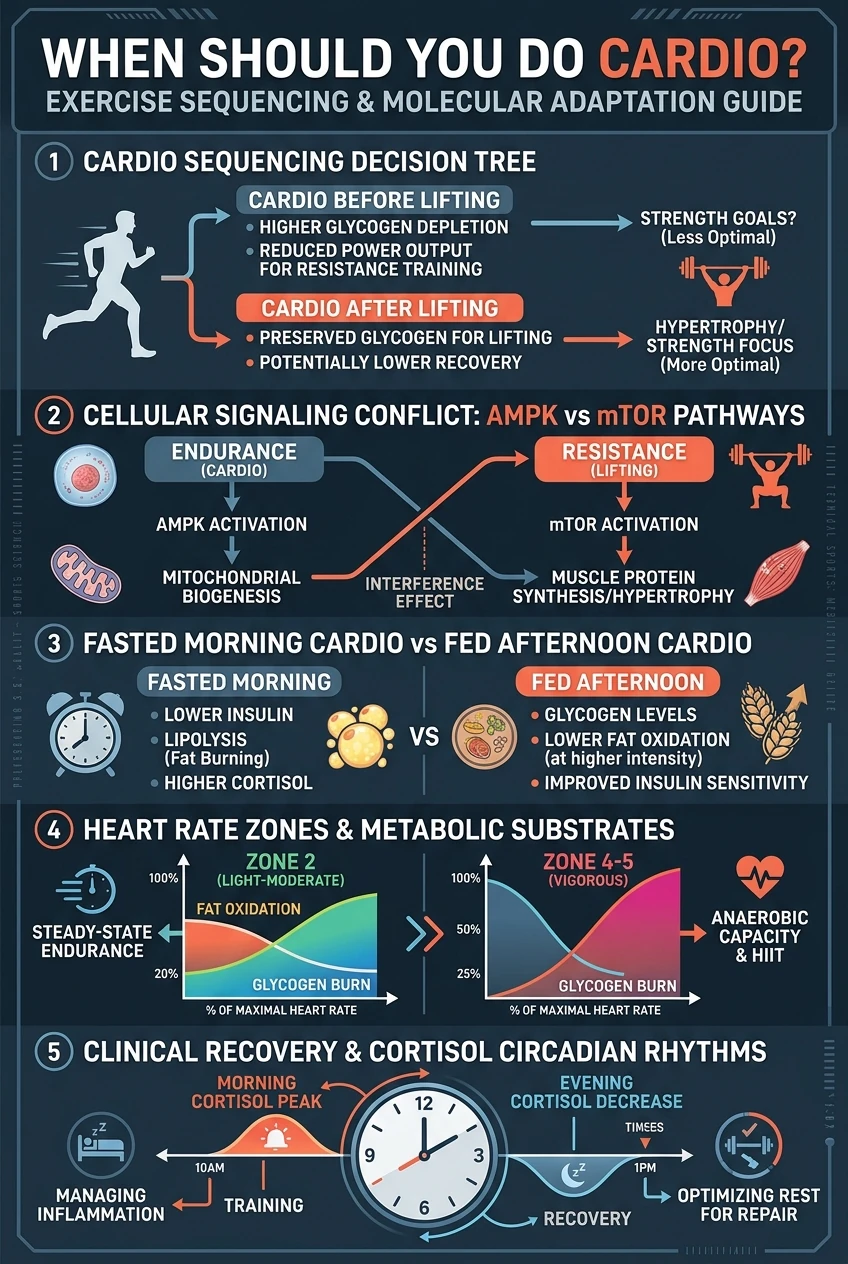
One of the most fiercely debated questions in exercise science and strength conditioning is: “When should you do cardio—before or after weight training?” While fitness influencers often preach dogmatic rules, exercise physiologists evaluate workout sequencing through the lens of cellular energy metabolism, substrate depletion, and intracellular signaling pathways.
Whether your primary objective is muscular hypertrophy, maximal strength, fat loss, or mitochondrial endurance, the sequence in which you execute your cardiovascular and resistance exercises alters your hormonal milieu, acute force production, and long-term adaptation. Below is an exhaustive, science-backed guide to workout sequencing, the molecular biology of the interference effect, and periodization protocols for every athletic goal.
1. The Molecular Biology of Concurrent Training: The Interference Effect
In 1980, Dr. Robert C. Hickson published a groundbreaking study demonstrating that combining endurance training with strength training attenuated strength gains compared to strength training alone. Modern molecular exercise physiology has identified the biochemical mechanism responsible for this phenomenon: the AMPK-mTORC1 signaling interference.
In a landmark review published in Sports Medicine (PubMed PMID: 24728927), Dr. Jackson Fyfe and colleagues detailed that resistance exercise activates the phosphoinositide 3-kinase (PI3K) / protein kinase B (Akt) signaling pathway, which stimulates mTORC1 and its downstream targets (p70S6K and 4E-BP1). This cascade accelerates ribosome biogenesis and initiates muscle protein synthesis (MPS) for myofibrillar repair and muscular growth.
Conversely, prolonged aerobic endurance exercise depletes intracellular ATP and increases the AMP/ATP ratio, which powerfully activates AMPK. While AMPK stimulates mitochondrial biogenesis via PGC-1α (peroxisome proliferator-activated receptor gamma coactivator 1-alpha) and enhances fat oxidation, it also phosphorylates tuberous sclerosis complex 2 (TSC2) and raptor, effectively shutting down mTORC1 signaling. Consequently, performing rigorous aerobic cardio immediately before or alongside resistance training dampens the hypertrophic response.
2. Why Strength Training Should Come Before Cardio (90% of Goals)
For individuals whose primary goals include building muscle, maintaining functional lean mass, or transforming physique composition, performing resistance training prior to cardiovascular exercise yields three major physiological advantages:
A. Preservation of Glycogen Stores for High-Threshold Motor Units
High-intensity resistance training relies almost exclusively on anaerobic glycolysis powered by intramuscular glycogen. Type IIx and Type IIa fast-twitch muscle fibers possess high glycolytic enzymatic capacity but fatigue rapidly when glycogen stores are depleted. Performing 30 to 45 minutes of moderate-to-high-intensity cardio prior to lifting depletes precious muscle glycogen, reducing peak power output, bar speed, and total volume load (Sets × Reps × Weight)—the primary drivers of progressive overload.
B. Prevention of Central Nervous System (CNS) Fatigue
Heavy compound movements (such as barbell squats, deadlifts, and overhead presses) require intense neurological coordination, spinal stability, and high-frequency motor unit firing. Cardiovascular exercise induces both peripheral muscular fatigue and central neurotransmitter shifts (elevated brain serotonin-to-dopamine ratios). Lifting weights in a pre-fatigued neural state degrades biomechanical form, increasing shear stress on spinal discs and surrounding joints.
C. Enhanced Lipid Oxidation (Fat Burning) via Post-Lift Cardio
When you perform intense strength training first, your body burns primarily circulating glucose and glycogen while triggering a surge of catecholamines (epinephrine and norepinephrine) and growth hormone. These lipolytic hormones mobilize stored triglycerides from subcutaneous adipocytes into free fatty acids. When you subsequently transition to low-intensity steady-state (LISS) cardio, your body preferentially oxidizes these mobilized fatty acids as fuel.

3. When Should You Prioritize Cardio First?
While lifting first is optimal for general fitness and body composition, there are specific clinical and athletic scenarios where cardiovascular training must take precedence:
- Endurance Sport Specificity: Distance runners, triathletes, competitive cyclists, and marathoners whose primary performance metric is maximal oxygen consumption (VO2 max), lactate threshold, or running economy must perform endurance workouts first with a fresh neuromuscular system.
- Cardiovascular Health & Blood Pressure Modulation: Individuals training specifically for endothelial health, blood pressure reduction, and arterial compliance benefit from prioritizing Zone 2 aerobic sessions when energy and cardiovascular focus are highest. Discover botanical synergies in our clinical guide on blood pressure herbs to lower hypertension naturally.
- Pre-Workout Dynamic Neuromuscular Warm-Up: A brief 5 to 8-minute low-intensity cardio warm-up (e.g., rowing, brisk incline walking, or light cycling) at <50% VO2 max is beneficial. This elevates core body temperature, increases synovial fluid secretion in articular joint capsules, and enhances nerve conduction velocity without depleting intramuscular glycogen.
4. Optimal Periodization Strategies for Concurrent Training
In a seminal sports science paper published in Sports Medicine (PubMed PMID: 24791914), Dr. Keith Baar demonstrated that strategic timing between endurance and resistance sessions minimizes signaling antagonism. Below are the three optimal scheduling architectures:
Protocol A: The 6-to-24-Hour Separation Protocol (The Gold Standard)
The ideal concurrent training structure separates resistance training and endurance conditioning into different sessions spaced by at least 6 hours, or ideally on alternating days. This allows acute AMPK phosphorylation to decline before activating mTORC1, allowing both mitochondrial adaptations and muscle protein synthesis to proceed unimpeded.
Protocol B: Same-Session Strength First, Low-Intensity Cardio Second
If busy schedules mandate completing both modalities in a single 60 to 75-minute window, dedicate the first 40 to 45 minutes to progressive heavy resistance training. Follow immediately with 15 to 20 minutes of Low-Intensity Steady State (LISS) cardio maintained strictly in Zone 2 (60% to 70% of maximum heart rate). Zone 2 cardio promotes active metabolic clearance of lactate and hydrogen ions without creating excessive systemic catabolism.
Protocol C: Fasted Morning Zone 2 Walking
A brisk 30 to 45-minute morning outdoor walk performed in a fasted state utilizes non-esterified fatty acids while stimulating circadian melatonin suppression through natural sunlight exposure. Because the intensity is well below the lactate threshold, it creates negligible neuromuscular fatigue, allowing you to lift heavy later in the afternoon.

5. Training Goal vs. Cardio Timing Decision Matrix
Use this clinical decision framework to match your primary fitness goal with the optimal workout sequence:
| Primary Fitness Goal | Recommended Sequencing | Cardio Intensity / Modality | Key Physiological Rationale |
|---|---|---|---|
| Maximal Muscle Growth (Hypertrophy) | Weights First, Cardio After (or Separate Days) | Zone 2 LISS (Incline Walk, Stationary Bike) | Preserves glycogen and prevents AMPK from inhibiting mTORC1 synthesis pathways. |
| Maximal Strength & Power | Weights First (Cardio on Separate Days) | Low-Impact Aerobic (Rower, Swimming) | Maximizes central nervous system motor unit recruitment and rate of force development. |
| Fat Loss & Body Recomposition | Strength First, HIIT or LISS Second | 15–20 min Moderate LISS or Post-Lift Intervals | Strength training depletes glycogen, priming the body for accelerated post-workout lipid oxidation. |
| Endurance Competition (5K, Marathon) | Cardio First, Strength Second | Target Race Pace / Intervals | Prioritizes sport-specific movement patterns, running economy, and aerobic capacity. |
| General Health & Longevity | Flexible (Whichever Promotes Consistency) | Zone 2 Aerobic Base (3–4x weekly) | Improves vascular compliance, lowers resting heart rate, and enhances metabolic flexibility. |
6. Clinician-Selected Cardiovascular & Training Recovery Essentials
Precision cardiovascular programming requires accurate heart rate biofeedback, optimal electrolyte hydration, and deep fascial recovery. Below are three premier tools vetted for athletic performance:
Top Evidence-Based Cardio & Recovery Essentials
Polar H10 Heart Rate Monitor Chest Strap
The undisputed gold standard for electrocardiographic ECG precision. Accurately tracks real-time heart rate zones to ensure your post-lift cardio stays strictly in fat-burning Zone 2 without crossing into catabolic anaerobic thresholds.
Liquid I.V. Hydration Multiplier Electrolyte Powder (16 Pack)
Utilizes science-backed Cellular Transport Technology (CTT) with an optimal sodium-glucose ratio to hydrate cells 2–3x faster than water alone. Replenishes critical minerals lost through intense aerobic sweat sessions.
TriggerPoint GRID Multi-Density Foam Roller (13-Inch)
Patented hollow-core multi-density grid surface mimics a physical therapist’s hands. Increases blood circulation to tight hamstrings, calves, and thoracic spine, accelerating muscle repair after heavy compound training.
Pairing your workout schedule with light, nutrient-dense fuel prevents hypoglycemia; explore our curated list of 25 healthy 100-calorie snacks for energy.
Related Clinical Cardiovascular & Metabolic Guides
- 8 Health Benefits of Tea: EGCG, Catechins & Exercise Metabolic Acceleration
- Clear Arteries Naturally: 5 Clinical Strategies for Endothelial & Cardiovascular Health
- Blood Pressure Herbs: 5 Clinically Proven Plants to Modulate Vascular Resistance
- Health Benefits of Seeds: Plant-Based Omega-3s & Exercise Glycogen Recovery
- Boosting Iron Naturally: Cellular Oxygenation & Endurance Performance
Frequently Asked Questions (Clinical FAQ)
Will doing cardio after weights cause muscle loss?
No, provided the cardiovascular work is kept at moderate low-to-medium intensity (Zone 2) for 20 to 30 minutes and total dietary protein intake remains sufficient (1.6 to 2.2 grams per kilogram of body weight). Excessive high-intensity chronic cardio combined with severe caloric restriction is what triggers catabolic muscle wasting.
Is fasted morning cardio superior for burning body fat?
While fasted cardio increases the acute percentage of fat oxidized during the exercise bout itself, 24-hour total energy expenditure and net caloric balance ultimately dictate long-term fat loss. Fasted cardio is effective for individuals who feel lighter and more energetic on an empty stomach, but it does not produce superior fat loss compared to non-fasted cardio when calories and macronutrients are equated.
Can I do HIIT (High-Intensity Interval Training) on weight lifting days?
Combining heavy compound resistance training with intense HIIT on the same day generates substantial neuromuscular and central nervous system fatigue. If you must do both, schedule HIIT on non-lifting days or separate them by at least 8 to 12 hours to prevent overtraining and performance decrements.
How much cardio should I do each week for optimal heart health?
The American Heart Association and global cardiovascular guidelines recommend a minimum of 150 minutes of moderate-intensity aerobic exercise (such as Zone 2 brisk walking or cycling) or 75 minutes of vigorous aerobic activity per week, ideally paired with at least two full-body strength training sessions.
Should I eat protein or carbohydrates immediately after lifting and before cardio?
If you are immediately continuing into 15 to 20 minutes of low-intensity cardio, water and electrolytes suffice. Consuming a post-workout meal rich in complete amino acids (25 to 40 grams of protein) paired with complex carbohydrates is best consumed within 45 to 60 minutes after all training is completed to maximize muscle protein synthesis and glycogen resynthesis.
Final Clinical Takeaway
Structuring your cardio and strength training workouts does not have to be complicated. For 90% of fitness enthusiasts seeking a lean, muscular, and functionally resilient physique, strength training should always come first, followed by gentle Zone 2 cardiovascular work or separating endurance sessions onto alternating days. By respecting the molecular signaling pathways of AMPK and mTORC1, you can build muscle, shred excess body fat, and optimize cardiovascular longevity without compromising your hard-earned gains.