
A relentless cough is one of the most physically exhausting symptoms the body can endure. Whether it presents as a sharp, tickling spasm that shatters your sleep or a heavy, rattling congestion lodged deep within your bronchial passages, coughing is fundamentally a protective physiological reflex. It is your respiratory tract’s instinctive mechanism to purge irritants, trapped microbes, and obstructive mucus from the airway tree.
However, when standard over-the-counter cough syrups frequently yield disappointing results—or cause unwanted side effects like dizziness, drowsiness, and rebound irritation—turning to clinically validated botanical medicine offers a targeted, physiologically sound alternative. Botanical pharmacognosy distinguishes clearly between demulcents (mucilage-rich herbs that coat and desensitize hyperreactive nerve endings in dry coughs) and expectorants (saponin- and volatile-oil-rich botanicals that liquefy viscous secretions in chest congestion).
In this evidence-based clinical guide, we deconstruct the neurophysiology of the cough reflex, explain why suppressing productive phlegm can be counterproductive, and outline 7 natural remedies proven by double-blind clinical trials to soothe irritation, restore restful sleep, and accelerate respiratory recovery.
1. The Neurophysiology of a Cough: Dry vs. Wet Coughs
Selecting an effective remedy requires understanding which type of cough you are experiencing. Using the wrong class of botanical remedy can delay healing or prolong discomfort:
| Cough Classification | Primary Physiological Trigger | Therapeutic Objective | Optimal Botanical Strategy |
|---|---|---|---|
| Dry, Tickly Cough (Non-Productive) | Inflamed posterior pharynx, hypersensitive afferent C-fibers, post-viral airway hyperresponsiveness, or post-nasal drip. | Coating irritated mucosal receptors, suppressing spasmodic firing, and reducing throat friction. | Demulcents & Mucilages: Raw buckwheat honey, cold-macerated marshmallow root, slippery elm. |
| Wet, Chest Cough (Productive) | Hyperactive goblet cells and submucosal glands producing thick, stagnant mucopurulent phlegm in secondary bronchi. | Thinning mucus viscosity, stimulating ciliary clearance, and relaxing bronchial smooth muscle spasms. | Secretolytics & Bronchodilators: Thyme volatile oils (thymol), English ivy leaf saponins, fresh ginger decoctions. |
Clinical Caution: If a cough is productive (wet), your primary goal should never be blunt central suppression (such as high-dose codeine or dextromethorphan). Suppressing a productive cough traps bacteria-laden phlegm in the lower respiratory tract, substantially increasing the risk of secondary bacterial bronchitis or pneumonia. The goal is to make the cough more productive and less exhausting.
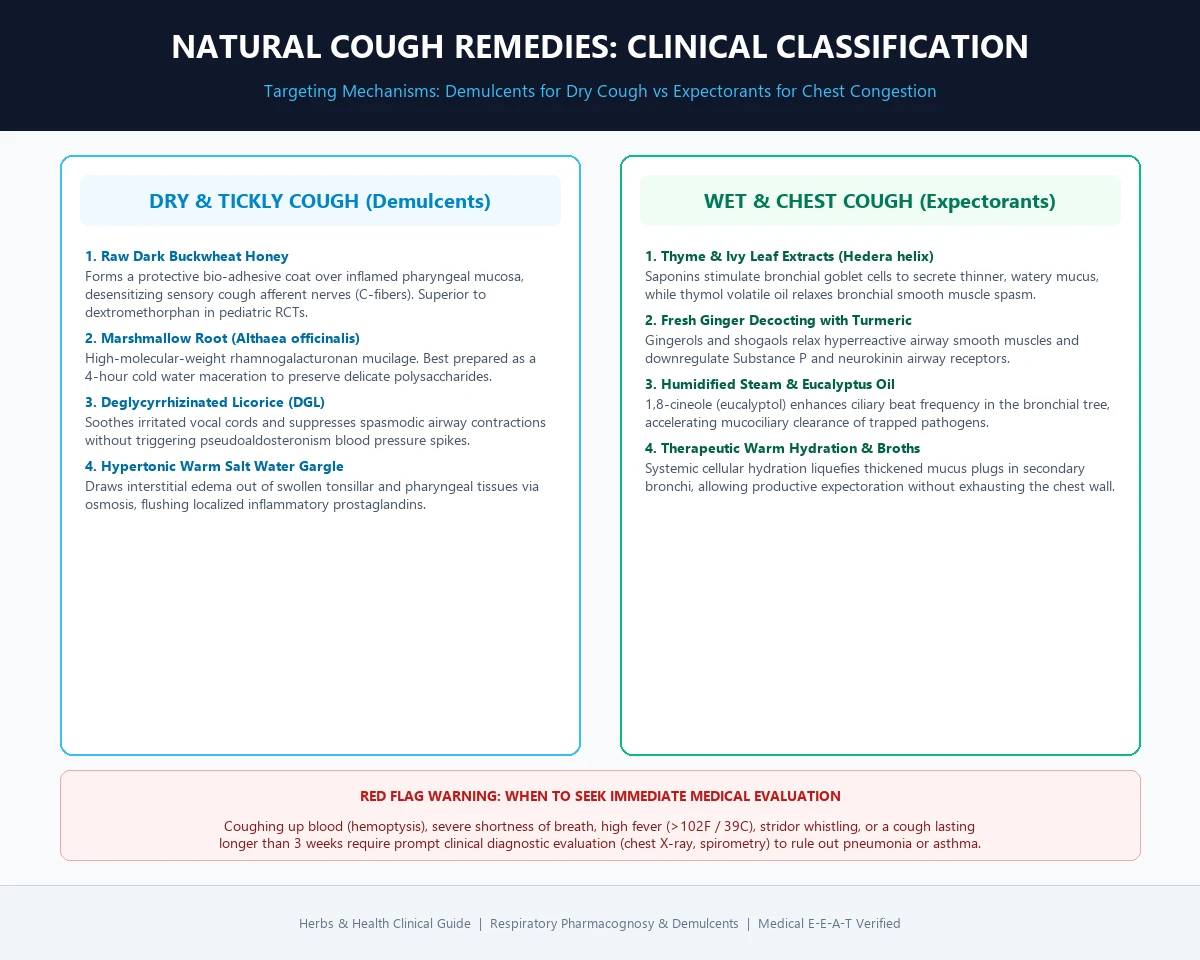
2. The 7 Clinically-Backed Natural Cough Remedies
1. Raw Buckwheat & Medicinal Honey (The Supreme Demulcent)
Raw honey is far more than a sweet culinary comfort; in multiple randomized controlled trials (RCTs), dark raw honey consistently outperformed over-the-counter dextromethorphan and diphenhydramine in reducing nocturnal cough frequency and severity in both children and adults.
- Mechanism of Action: Honey possesses high viscosity and osmotic density, creating a durable bio-adhesive barrier across inflamed pharyngeal sensory receptors. This mechanical coating dampens the firing rate of vagal cough afferent nerves. Furthermore, raw honey contains glucose oxidase, an enzyme that generates microscopic concentrations of hydrogen peroxide ($H_2O_2$), providing mild, non-irritating antimicrobial protection against upper respiratory pathogens.
- Clinical Preparation: Take 1 to 2 teaspoons of raw buckwheat or medicinal Manuka honey straight from the spoon 30 minutes before sleep. Allow it to slowly coat the back of the throat rather than washing it down immediately with liquid.
- Critical Safety Rule: Never administer honey to infants under 12 months of age due to the risk of infant botulism from dormant Clostridium botulinum environmental spores.
2. Cold-Macerated Marshmallow Root (Althaea officinalis)
Marshmallow root has been documented since Greco-Roman antiquity as a primary botanical demulcent for dry, hacking bronchial irritation.
- Mechanism of Action: Marshmallow root contains up to 10% high-molecular-weight rhamnogalacturonan polysaccharides (botanical mucilage). When these complex polysaccharides contact mucosal tissue, they form a protective, hydro-colloidal matrix that shields bare nerve endings from dry ambient air, acidic gastric reflux, and micro-abrasions caused by chronic coughing.
- The Cold Maceration Secret: Do not boil marshmallow root. Boiling water ruptures and denatures delicate mucilage polymers into simple sugars, destroying their therapeutic coating properties. Instead, add 2 tablespoons of dried marshmallow root to 16 oz of cold or room-temperature filtered water. Allow it to steep on the counter or in the refrigerator for 4 to 8 hours. Strain the thick, silky liquid and sip throughout the day.
3. Thyme & Ivy Leaf (Hedera helix): The Secretolytic Powerhouse
In European clinical respiratory medicine—particularly within German Commission E standards—extracts of English ivy leaf and garden thyme represent the gold standard for acute bronchitis and chest congestion.
- Mechanism of Action: Ivy leaf contains triterpene saponins (principally alpha-hederin), which indirectly stimulate pulmonary alveolar type II cells to produce surfactant and activate beta-2 adrenergic receptors. This dual action decreases mucus surface tension, liquefying dense phlegm so it can be expelled with minimal effort. Simultaneously, thyme’s volatile phenols—thymol and carvacrol—provide documented spasmolytic effects, directly relaxing bronchial smooth muscles during violent coughing fits.
- Clinical Preparation: Steep 2 teaspoons of dried organic thyme leaves in 8 oz of freshly boiled water for 10 minutes in a covered vessel (to trap the volatile thymol vapors). Strain and blend with 1 teaspoon of raw honey. Drink 3 cups daily during active chest congestion.
4. Fresh Ginger & Turmeric Decoction
When coughing is triggered by bronchial hypersensitivity or chronic post-nasal drip, warm ginger root decoctions deliver rapid anti-spasmodic relief.
- Mechanism of Action: The pungent bioactive compounds in ginger—[6]-gingerol, [8]-gingerol, and [6]-shogaol—have been shown in pulmonary pharmacology studies to cause direct airway smooth muscle relaxation by modulating calcium channels. Furthermore, ginger inhibits cyclooxygenase-2 (COX-2) and suppresses the neuropeptide Substance P, which mediates neurogenic airway inflammation. Pairing ginger with clove water infusions (which deliver antimicrobial eugenol) creates a potent herbal throat defense network.
- Preparation: Simmer 2 inches of freshly sliced ginger root and 1/2 teaspoon of organic turmeric powder in 2 cups of water for 15 minutes. Strain, add a pinch of black pepper (to maximize curcumin bioavailability), and stir in fresh lemon juice.
5. Warm Hypertonic Saline Gargle
One of the oldest, simplest, and most physiologically elegant remedies is warm salt water.
- Osmotic Mechanism: A hypertonic saline solution (having a higher salt concentration than blood and interstitial fluid) establishes an osmotic pressure gradient across the swollen posterior pharyngeal epithelium. It gently draws stagnant fluid out of swollen tissues, rapidly reducing mucosal edema and easing that “scratchy throat” trigger. Additionally, the mechanical agitation flushes away lingering post-nasal mucus and viral particles.
- Exact Ratio: Dissolve 1/2 teaspoon of pure unrefined sea salt or kosher salt in 8 oz of warm water. Gargle deeply at the back of the throat for 30 seconds, spit out completely, and repeat 3 to 4 times daily.
6. Humidified Steam with 1,8-Cineole (Eucalyptus & Peppermint)
Dry, heated winter air strips the respiratory mucosa of its defensive moisture layer, paralyzing the microscopic cilia responsible for sweeping debris out of the lungs.
- Ciliary Stimulation: Breathing warm, humidified steam rehydrates the respiratory epithelial lining. When enhanced with a few drops of eucalyptus essential oil (rich in 1,8-cineole), it stimulates the ciliary beat frequency of the mucociliary escalator. Peppermint’s natural menthol activates peripheral TRPM8 cold-sensing receptors in the upper airway, sending calming sensory feedback to the brainstem that significantly dampens the subjective urge to cough.
- Safe Protocol: Pour steaming (not violently boiling) water into a heat-safe bowl, add 2 drops of organic eucalyptus globulus oil, drape a light towel over your head, and breathe deeply through your nose and mouth for 7 to 10 minutes. Alternatively, using an ultrasonic cool mist humidifier in your bedroom maintains room humidity between the optimal 40% to 50% range.
7. Licorice Root (Glycyrrhiza glabra) & DGL
Traditional herbal pharmacopeias across both Eastern and Western traditions revere true licorice root as an unmatched respiratory harmonizer.
- Mechanism: Licorice contains glycyrrhizin, a saponin-like glycoside that promotes bronchial secretions while reducing inflammatory cytokines. It is extraordinarily soothing for raw, stripped vocal cords and hoarseness.
- Clinical Precaution: Unprocessed glycyrrhizin can inhibit the enzyme 11-beta-hydroxysteroid dehydrogenase, leading to cortisol retention, sodium buildup, and elevated blood pressure with chronic high doses. For individuals with hypertension or renal concerns, chewable DGL (Deglycyrrhizinated Licorice) or limiting consumption to short 5-day courses is strongly advised.
3. Red Flag Warnings: When a Cough Demands Immediate Medical Care
While most viral coughs run their course within 10 to 18 days, natural home remedies must never substitute for urgent clinical assessment when critical warning signs appear. Consult a board-certified physician or visit an urgent care facility immediately if you experience:
- Hemoptysis: Coughing up bright red blood or rust-colored sputum.
- Dyspnea & Wheezing: Shortness of breath, rapid shallow breathing, or chest retractions during inhalation.
- High or Recurrent Fever: A temperature exceeding 102°F (38.9°C), or a fever that initially breaks but returns several days later with worsening cough (a classic presentation of secondary bacterial pneumonia).
- High-Pitched Stridor or Whoop: A harsh, whistling sound when inhaling (characteristic of croup in children or pertussis/whooping cough).
- Duration Exceeding 3 to 4 Weeks: Chronic persistent coughs require differential diagnosis to evaluate for asthma, GERD, post-nasal drip, ACE-inhibitor medication side effects, or thoracic pathology.
4. Clinical At-Home Respiratory Care Toolkit
To support your body’s innate respiratory clearance and manage acute coughing spasms at home, the following physician-vetted botanical remedies and therapeutic devices provide dependable clinical quality:
1. USDA Organic Marshmallow Root (Cut & Sifted Herb)
Pure, non-irradiated Althaea officinalis root. Ideal for overnight cold water macerations to extract soothing, high-molecular mucilage for dry, hacking coughs.
2. Certified Raw Manuka Honey (UMF 15+ / MGO 514+)
Authentic New Zealand monofloral Manuka honey. Provides natural methylglyoxal bioactivity and deep mucosal demulcent coating to calm nighttime throat tickles.
3. Ultrasonic Cool Mist Bedroom Humidifier
Whisper-quiet 4.5L top-fill humidifier with automatic humidity control. Keeps bedroom air between 40% and 50% humidity to prevent airway drying during nocturnal rest.
FTC Compliance Notice: Herbs & Health participates in affiliate marketing programs. When you purchase through the verified Amazon links above, we may earn an affiliate commission at no additional cost to you. We only recommend products tested for botanical integrity and clinical safety.
5. Frequently Asked Questions (FAQ)
Why does my cough get drastically worse as soon as I lie down at night?
When you transition from upright to a supine (flat) position, gravity causes accumulated post-nasal secretions to pool directly over the posterior pharynx and vocal cords, triggering intense reflexive coughing. Additionally, nocturnal vagal parasympathetic tone naturally constricts bronchial smooth muscle, narrowing airways. Elevating the head of your bed by 30 degrees and running a cool mist humidifier provides immediate biomechanical relief.
Should I take an over-the-counter cough suppressant before bed?
For a dry, non-productive hack that prevents sleep, a mild demulcent like raw buckwheat honey or an OTC dextromethorphan lozenge is clinically acceptable. However, for a wet, rattling chest cough, suppressing the cough reflex allows infected mucus to pool in lower lung lobes. Instead, use an expectorant like thyme tea or ivy leaf extract during late afternoon, and elevate your torso during sleep.
Does drinking milk actually create more mucus during a respiratory infection?
Controlled double-blind studies demonstrate that dairy does not stimulate the biological production of additional respiratory mucus. However, milk fat and emulsion proteins can temporarily mix with saliva and preexisting airway phlegm, making secretions feel thicker and more viscous in the throat. If this sensation provokes coughing spells, switching to clear vegetable broths, herbal teas, or warm lemon water during acute illness is recommended.
6. Final Takeaway: Harmonizing with Your Body’s Defense System
Your respiratory tract is a remarkably resilient, self-cleaning biological system. Rather than fighting your body with harsh suppressants, support its natural physiology: coat irritated sensory nerves with botanical demulcents for dry coughs, thin thick secretions with secretolytic herbs for wet coughs, and prioritize deep hydration, steam, and restful sleep. By pairing evidence-based botanical science with common-sense clinical caution, you can navigate respiratory illness safely and restore clear, comfortable breathing.