
Few joints in the human body endure as much relentless repetitive stress as the wrist. From marathon typing sessions and smartphone scrolling to gripping heavy gym weights or tools, repetitive strain injuries (RSI) frequently trigger stiffness, sharp pain, or finger numbness that disrupts work and sleep.
Anatomically, the human wrist is a masterpiece of biomechanical engineering. Within an extraordinarily compact space, eight carpal bones, over twenty delicate tendons, three major peripheral nerves, and an intricate lattice of fibrous ligaments work in unison to grant the human hand its dexterous precision and gripping power. However, this dense anatomical packaging makes the wrist uniquely vulnerable to compression syndromes, micro-tearing, and chronic tendinopathy.
Relying solely on nonsteroidal anti-inflammatory drugs (NSAIDs) merely silences the body’s alarm signal without addressing underlying mechanical imbalances. Achieving lasting wrist pain relief requires an integrative clinical strategy: identifying the exact anatomical source of your discomfort, performing targeted nerve-gliding and tendon-stretching exercises, correcting poor desk ergonomics, and utilizing proven natural anti-inflammatory therapies. Below is an authoritative, evidence-based guide to restoring pain-free wrist mobility.
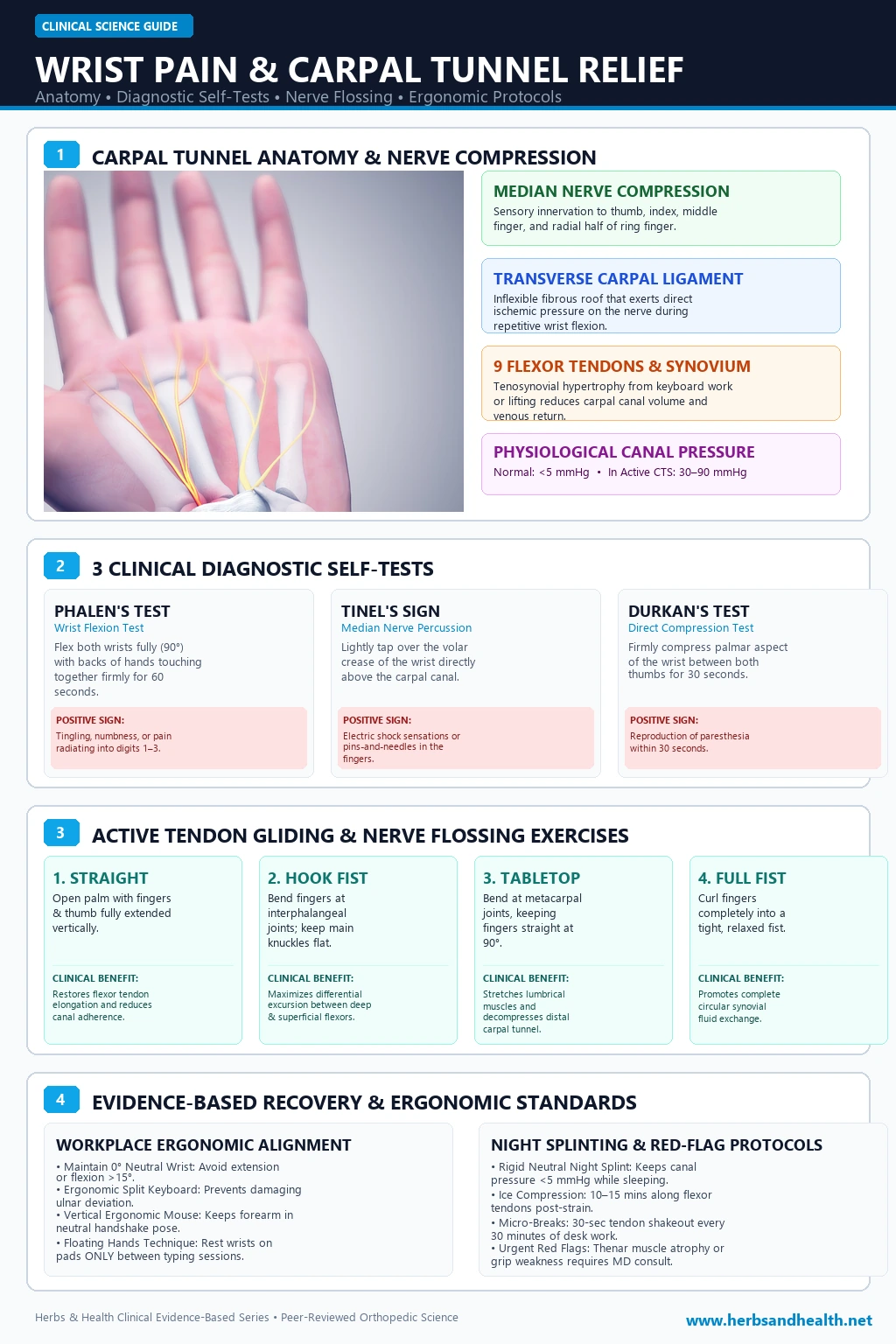
📋 Medical Summary & Clinical Key Takeaways
- Etiological Spectrum: Wrist pain primarily stems from median nerve compression (Carpal Tunnel Syndrome), abductor/extensor tenosynovitis (De Quervain’s), flexor/extensor tendinopathy, or triangular fibrocartilage complex (TFCC) tears.
- Clinical Provocation Triage: Physical examination maneuvers (Phalen’s test, Tinel’s percussion, and Finkelstein’s test) reliably differentiate focal nerve entrapment from acute tenosynovial sheath inflammation.
- Evidence-Based Neurodynamics: Randomized trials confirm that median nerve gliding exercises paired with nocturnal neutral splinting reduce intraneural edema and restore mechanical axon excursion.
- Ergonomic & Botanical Synergy: Adopting vertical 57° ergonomic mice, preserving neutral wrist angles, and applying topical Arnica montana provide comprehensive, non-surgical symptom relief.
Differential Diagnosis: What is Actually Causing Your Wrist Pain?
Not all wrist pain is created equal. Because multiple tendons and nerves converge within the wrist, pinpointing the specific anatomical tissue involved is essential for choosing the correct rehabilitative protocol:
1. Carpal Tunnel Syndrome (CTS)
Carpal Tunnel Syndrome is the most frequent compressive peripheral neuropathy in clinical medicine. The median nerve travels from the forearm into the hand through a rigid, unyielding passageway called the carpal tunnel, bordered by the eight carpal bones and roofed by the thick transverse carpal ligament. Alongside the median nerve run nine flexor tendons.
Repetitive finger flexion, hormonal fluid shifts (such as pregnancy or thyroid dysfunction), or poor wrist posture inflames these flexor sheaths. Swelling within the unyielding carpal tunnel compresses the median nerve, causing nocturnal numbness, tingling, and radiating pain into the first three digits.
2. De Quervain’s Tenosynovitis (“Smartphone / Gamer’s Thumb”)
De Quervain’s tenosynovitis is a painful inflammation of the synovial sheath enclosing two specific tendons that control thumb movement: the abductor pollicis longus (APL) and extensor pollicis brevis (EPB). These tendons pass through a tight fibrous tunnel over the radial styloid on the thumb side of the wrist.
Repetitive thumb abduction and radial deviation—such as one-handed texting on smartphones, gaming with controllers, lifting infants under the armpits, or swinging tennis rackets—generates severe frictional shear stress. Sufferers experience sharp, catching pain directly at the base of the thumb that radiates up the forearm when forming a fist, gripping coffee mugs, or turning doorknobs.
3. Wrist Tendinopathy (Flexor & Extensor Tendinitis)
Repetitive eccentric loading without adequate biological recovery induces microscopic degenerative tears in the tendon fibers. Flexor tendinitis causes dull, persistent aching along the anterior (palm-side) wrist, aggravated by heavy gripping or pull-ups. Extensor tendinitis affects the posterior (dorsal) surface of the wrist, triggered by prolonged typing with wrists bent upward in extension.
4. Triangular Fibrocartilage Complex (TFCC) Tears
The TFCC is a specialized cartilaginous disc and ligamentous complex situated on the ulnar (pinky-finger) side of the wrist, functioning similarly to the meniscus in the knee. It cushions the wrist joint and stabilizes the distal radioulnar joint during rotational loading. TFCC injuries produce deep, localized ulnar wrist pain, clicking sensations, and weakness when pushing up out of an armchair or twisting jars open.
Simple Self-Diagnostic Tests: What Physical Therapists Check
Before beginning an exercise routine, these three classic orthopedic physical assessment tests can help clarify whether your pain stems from median nerve compression or thumb tendon sheath friction:
- Phalen’s Maneuver: Press the backs of both hands together at 90° wrist flexion for 60 seconds. Numbness or tingling in the thumb, index, or middle finger confirms median nerve compression.
- Tinel’s Sign: Lightly tap over the middle of the flexor wrist crease. An electric tingling radiating into the fingers signals active nerve irritability.
- Finkelstein’s Test: Tuck your thumb into your fist and tilt your wrist toward your little finger. Sharp radial thumb base pain confirms tenosynovial sheath inflammation.
Emergency Red Flags: When to See an Orthopedic Specialist Immediately
While most repetitive strain injuries respond remarkably well to conservative physical therapy and ergonomic corrections, certain clinical presentations demand immediate medical imaging and orthopedic evaluation:
- Anatomical Snuffbox Tenderness Post-Fall: Pain in the depression at the thumb base after a fall suggests a scaphoid fracture with retrograde avascular necrosis risk requiring prompt radiography.
- Thenar Muscle Atrophy: Visible flattening or shrinking of the muscular thumb pad indicates severe axonal loss from chronic median nerve compression.
- Infectious Tenosynovitis: Sudden severe swelling, erythema, heat, and fever signal deep synovial sheath infection requiring emergency drainage.
5 Evidence-Based Stretches & Nerve Flossing Exercises
When nerves and tendons become chronically inflamed, they develop microscopic adhesions that bind them to surrounding fascial sheaths. Performing sequential nerve glides (flossing) and antagonistic muscle strengthening restores smooth glide pathways, promotes lymphatic clearance, and relieves trapped mechanical tension:
1. Median Nerve Gliding (Nerve Flossing)
Nerve flossing gently mobilizes the median nerve through the carpal tunnel like dental floss, breaking microscopic adhesions without over-stretching sensitive neural tissue. Rigorous systematic reviews and meta-analyses published in the Journal of Orthopaedic & Sports Physical Therapy (PubMed PMID: 28841436) prove that targeted neurodynamic mobilization techniques significantly diminish intraneural carpal tunnel pressure, improve conduction velocities, and deliver superior functional pain relief compared to immobilization alone. Perform this 6-step sequence smoothly:
- Step 1: Make a gentle fist with your wrist in a neutral position.
- Step 2: Open your fingers fully, extending them straight with the thumb held close to the index finger.
- Step 3: Gently bend your wrist backward into extension while keeping fingers straight.
- Step 4: Extend your thumb outward as far as comfortable.
- Step 5: Turn your palm upward toward the ceiling (supination).
- Step 6: With your opposite hand, gently apply slight stretch to the extended thumb for 3 seconds. Release and repeat the cycle 5 times, twice daily.
2. The Prayer & Reverse Prayer Stretches
To stretch tight flexor tendons, place palms flat together in front of your chest in a prayer position with elbows flared outward. Slowly lower your hands downward toward your waistline while keeping palms pressed flat until you feel a gentle, comfortable stretch across the anterior wrists and forearms. Hold for 20 seconds, then reverse by pressing backs of hands together pointing downward. For holistic kinetic-chain stretching and guided mindful decompression, explore the restorative movement flows in our guide to yoga and natural healing remedies.
3. Finger Extensor Resistance Training
Most computer workers suffer from profound muscular imbalance: the wrist flexors are chronically tight from typing and clicking, while the extensor digitorum muscles on the back of the forearm are chronically weak and inhibited. Wrap a wide rubber band or silicone extensor resistance band around all five fingertips. Slowly open your hand outward against the elastic resistance, hold for 2 seconds, and return smoothly. Perform 3 sets of 15 repetitions daily to restore muscular symmetry.
4. Upstream Myofascial Release
Wrist pain frequently originates further up the kinetic chain. The pronator teres muscle in the upper forearm and the brachioradialis can entrap branches of the median and radial nerves before they ever reach the wrist. Similarly, deep pelvic and lumbar misalignments force compensatory shoulder and forearm guarding; learn how to release deep postural tension with our protocol to unlock your QL muscles naturally. Using a tennis ball or your opposite thumb, apply firm circular pressure along the upper forearm muscles below the elbow for 2 minutes to release muscular trigger points.
Ergonomic Redesign: Stopping Strain at the Source
You cannot exercise your way out of eight hours of daily ergonomic abuse. The single most crucial rule of wrist ergonomics is maintaining a neutral wrist angle. Because poor workstation posture cascades from spinal slump directly into shoulder protraction and wrist collapse, pair your desk adjustments with our foundational protocols for back pain relief and spinal ergonomics:
- The Neutral 0-Degree Zone: Carpal tunnel pressure is lowest when the wrist is straight (0–5° extension). Typing with wrists cocked at 30° elevates internal pressure up to six-fold, impairing nerve microcirculation.
- Vertical Ergonomic Mouse: Standard mice force full forearm pronation. A 57° vertical ergonomic mouse places the forearm in a neutral “handshake” posture, eliminating pronator strain and carpal compression.
- Nighttime Splinting: Sleeping with wrists flexed under pillows spikes nocturnal carpal pressure. A contoured splint worn exclusively at night preserves neutral alignment, allowing tenosynovial healing.
Natural Anti-Inflammatory Protocols
Alongside biomechanical therapy, targeted topical and systemic natural compounds provide potent anti-inflammatory relief without gastrointestinal irritation:
- Topical Arnica Montana: Derived from the European mountain daisy, homeopathic and topical arnica contains active sesquiterpene lactones that downregulate inflammatory nuclear factor kappa B (NF-kB), clinically shown to relieve acute sprain pain and reduce localized soft-tissue swelling.
- Curcumin & Boswellia serrata: Curcumin (from turmeric) suppresses COX-2 inflammatory enzymes, while boswellic acids specifically inhibit 5-lipoxygenase (5-LOX), the enzymatic pathway responsible for pain-inducing leukotrienes in chronic tendinopathy. Clinical musculoskeletal trials published in BMC Complementary and Alternative Medicine (PubMed PMID: 29315865) confirm that standardized curcuminoids paired with boswellic acids provide potent anti-inflammatory analgesia comparable to prescription NSAIDs without gastrointestinal toxicity.
- Contrast Hydrotherapy: Submerge your forearm and wrist in warm water for 3 minutes, then immediately switch to cold water for 1 minute. Repeating this cycle three times creates a natural vascular pumping action that flushes stagnant inflammatory metabolic waste and accelerates tissue oxygenation.
Recommended Wrist Recovery & Ergonomic Essentials
These three clinically proven, user-tested tools provide nighttime joint stabilization, topical botanical pain relief, and muscular rehabilitation:
1. Mueller Fitted Wrist Support Brace (Nighttime Splint)
Ergonomically contoured wrist brace featuring a rigid palmar spoon that holds the joint in the optimal neutral 0-degree posture. Highly breathable fabric designed specifically for comfortable nighttime sleeping to relieve Carpal Tunnel Syndrome.
2. Boiron Arnicare Gel (Topical Arnica Montana)
Non-greasy, fast-absorbing botanical pain relief gel powered by pure mountain arnica. Clinically studied to soothe joint soreness, tendon stiffness, and repetitive strain discomfort without synthetic fragrances or skin irritation.
3. Vive Hand Strengthener & Finger Extensor Bands
Complete hand therapy kit featuring progressive resistance grip strengtheners and silicone finger extensor bands. Specifically engineered to rebuild extensor balance, relieve flexor dominance, and stabilize wrist tendons.
Related Clinical & Musculoskeletal Guides
- Back Pain Relief: Proven Causes, Red-Flag Symptoms & Natural Recovery Strategies
- Unlock Your QL Muscles: Relieve Deep Lower Back Tension Naturally
- Yoga & Mind-Body Healing: Science-Backed Movement & Herbal Synergy
- What is Eczema? Causes, Common Types, Triggers & Natural Barrier Relief
- Dry, Itchy Skin Relief: Causes, Lipid Barrier Science & Natural Remedies
Frequently Asked Questions (FAQ)
Should I apply ice or heat to my painful wrist?
In acute flare-ups (sharp, burning, swollen pain resulting from sudden overuse), apply ice packs wrapped in a thin towel for 15 minutes to constrict dilated capillaries and numb pain receptors. For chronic, dull, tight, or stiff wrist pain without acute swelling, apply moist heat for 15 minutes to loosen rigid tendons, enhance collagen elasticity, and stimulate blood flow prior to performing stretches.
Should I wear a wrist brace all day long while working?
Generally, no. Wearing a rigid brace 24/7 causes surrounding wrist and forearm muscles to atrophy, creating secondary weakness. Physical therapists recommend wearing a rigid splint during sleep (when unconscious wrist flexion spikes carpal tunnel pressure) and during acute high-stress tasks, while leaving the wrist free to move through full, pain-free range of motion during routine daytime activities.
Does cracking your wrists or knuckles cause arthritis?
No. Multiple peer-reviewed epidemiological studies have debunked this myth. The “popping” sound is caused by tribonucleation—the rapid collapse and formation of microscopic nitrogen gas cavitation bubbles within the synovial fluid as the joint capsule momentarily expands. While painless cracking is harmless, cracking accompanied by pain or swelling indicates ligamentous laxity or cartilage damage that requires clinical evaluation.
Can Carpal Tunnel Syndrome be resolved permanently without surgery?
Yes. For mild to moderate cases, published clinical trials show that conservative management—combining nighttime neutral splinting, nerve-gliding exercises, ergonomic keyboard adjustment, and anti-inflammatory therapies—achieves full symptom resolution in up to 70% to 80% of patients, eliminating the need for surgical transverse carpal ligament release.
Medical & Physical Therapy Disclaimer: This article is intended strictly for educational and informational purposes and does not substitute for professional orthopedic medical advice, clinical diagnosis, or personalized physical therapy treatment. If your wrist pain follows an acute traumatic impact, causes severe persistent numbness, or results in progressive hand weakness, seek in-person evaluation from a licensed orthopedic physician or physical therapist immediately.